

In this week’s Sunday Morning Quarterback, let’s look both backward and forward as we arrive at the opening of the long college football offseason.
Spring practices concluded at the FBS level over the last weekend of April, and the FCS wrapped things up yesterday with the final spring games at Dartmouth and New Hampshire. Now Division I college football is headed into the long offseason, as we wait out the 111 days from Cinco de Mayo until the kickoff game between Florida and Miami on Aug. 24.
What that affords us is nearly four months of opportunity for both introspection and projection. There will be opportunities to look back at what happened both last year and historically, and there will also be plenty of opportunities to look ahead to what might transpire in the upcoming campaign.
For me personally, this particular point in time serves as something of a fulcrum in my life as a college football fan. Next year, for the first time in my life, I will get to see what life is like for more than 150 million people in the United States as I move to the Eastern time zone. My wife and I will be packing up from the Bay Area, where we spent the past few years after more than a decade in Oregon, and moving to Pennsylvania as I start up the journey toward a PhD at Penn State.
This is going to have some impacts on my personal college football fanaticism, with Saturdays taking on a far different look than I can probably imagine. But let’s use this relocation as an opportunity to look at how time zones and geography more generally impact gridiron fanaticism.
The impact of time zone changes on a college football fan
The biggest difference that I will experience next season is obviously moving the schedule forward three hours relative to what I have long known. It will be a circadian fluctuation for me, as the clock winds ahead in a way I have never really experienced as a football fan.
No longer will college football mean waking up by 9:00 a.m. to start watching and writing about the games of the week; now that time pushes back to noon, when I have become accustomed to the start of the second slate of games. What that also means is that I will also get an empathetic viewpoint of Pac-12 After Dark and late-night Mountain West action ending long after midnight.
Growing up in Wyoming, games started at 10:00 am. Even when we would travel to visit family back in Wisconsin for Thanksgiving or Christmas breaks, it always felt weird having to wait until 11:00 am for the opening kickoff of the day.
Last year, when I traveled to the Dallas/Fort Worth Metroplex for a symposium in Frisco, even going ahead two hours was an anomaly I rarely experience. My next relocation will be one that takes the time zone shift to its extreme in the contiguous United States. I will have to adjust to a new paradigm of waiting through the entire morning for football to begin.
Geography, stadium size, and college football fanaticism
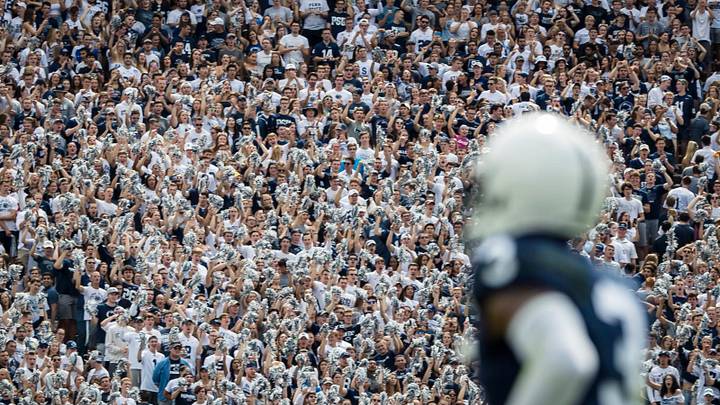
I will also be moving to a place unlike any other I have experienced as a college football fan. While places like Oregon can boast some passionate fans, the sheer volume of fanaticism just can’t compare to a place like State College. Autzen Stadium holds 60,000 fans, while Beaver Stadium can pack in 110,000 as they did most recently against Ohio State in 2017.
And as I learned on my visit to campus in April, upwards of 300,000 individuals flood State College for home games just to sit in proximity to the stadium and live vicariously as they hear the crowd noise preempt the TV feed at their tailgates.
Fanaticism comes in all forms, and perhaps the one that is most lasting is the simple fact that there is no such thing as “one size fits all” when it comes to this work. That is the most critical part. Remaining vigilant against discrimination is not just good business, but it also provides a venue for millions of organisms to live undisturbed.
So hang on and enjoy the last vestiges of cool weather while it still remains. Success is never linear, and depending on where you live in the United States football will either transpire soon or in the same area of the world.
 Add us as a preferred source on Google