

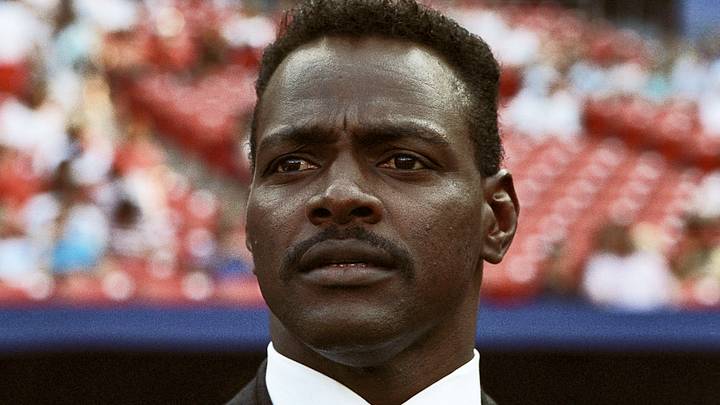
When college football was predominately segregated (especially in the south), there were few places where black high school players could play big-time college football. The Big Ten became a haven for southern black players in the 1950s and 1960s.
Players like Willie Thrower and Sandy Stephens found success in the Big Ten. For the most part, however, if black players wanted to play college football, they went to Historically Black Colleges and Universities (HBCUs).
For more than 20 years, from the 1950s to the 1970s, HBCUs produced more black NFL players than anywhere else. Two players on this list, Doug Williams and Buck Buchanan were barrier breakers.
Williams was the first black quarterback drafted in the first round, and Buchanan was the first black player drafted No. 1 overall. The 1970s was perhaps the last great period of black college football players going to the NFL.
Not only was Williams the first drafted in the first round, but he was also the first black quarterback Heisman finalist from an HBCU.
HBCU football has produced some of the most talented players in college football history

No. 10: Jerry Rice, WR, Mississippi Valley State
Widely regarded by many as the greatest football player in NFL history, Jerry Rice is possibly the greatest wide receiver at any level setting both collegiate and professional record. Though there was some controversy about Rice’s 40-yard dash time at the NFL combine, fellow wide receiver John Taylor (who could have also made this list) said of Rice, “I never saw a defender catch him from behind.”
Before Rice was rewriting the NFL record book, the Crawford, Miss., native was doing the same on the Mississippi Delta. Rice played for Mississippi Valley State under HBCU legend Archie Cooley. Under “Gunslinger” Cooley, the Delta Devils were the first teams to use a no-huddle, spread offense.
Rice had 66 receptions, and 1,133 yards, and seven touchdowns as a sophomore as he and quarterback Willie Totten began the run their version of spread offense known as the “Satellite Express”. In 1983, Rice set records for receptions (102) and receiving yards (1,450) to break those records in 1984.
In 1984, Rice had 112 receptions and 1,845 yards with an NCAA record, 27 touchdowns an all-division record. The 1984 MVSU team had one of the best offensive seasons in college football history, scoring 628 points in 11 games (57.1 per game). In 2010, Rice was part of the inaugural class of the Black College Football Hall of Fame.
No. 9: Willie Totten, QB/HC, Mississippi Valley State
When writers make lists about quarterbacks who ran a version of the spread (air-raid, run and shoot, K-gun), names like Robby Bosco, Ty Detmer, Timmy Chang or Case Keenum arise. Heisman Trophy winners Andre Ware and Dave Klingler won those awards, running a variant of the spread.
One name that writers need to add is former Mississippi Valley State quarterback Willie Totten. Because Jerry Rice had the great Hall of Fame career, Totten goes largely forgotten, which is unfortunate. Frankly, Rice needed a quarterback to throw him all of those passes.
Totten held over 50 passing records at one time and still holds several to this day. Totten is the SWAC all-time leader in touchdown passes and is second in yards to Steve McNair (also on this list).
The version of the spread innovated by MVSU head coach Archie “Gunslinger” Cooley often featured five wide receivers and Totten calling plays at the line of scrimmage. The Delta Devils scored 57 points per game in 1984.
Totten and the Delta Devils did not huddle and scored 40 or more points in nine of 11 games. Totten has been forgotten in the annals of college football history. However, down in Itta Bina, Miss., Totten and the Delta Devils spread teams out before lots of teams.

No. 8: Doug Williams, QB/HC, Grambling State
Former Grambling State legend Doug Williams had quite the journey to get to Super Bowl XXII, throwing four touchdowns in the second quarter. For Williams, it starts at Chaneyville High School in Zachary, La. After a stellar career in high school, Williams would take his talents to Grambling, La., to play for the legendary coach, Eddie Robinson.
While at Grambling, Williams was a four-year starter, winning 36 games and three SWAC championships. In Williams’ senior year, 1977, he threw for 3,286 yards and 38 touchdowns, leading the nation in yards from scrimmage. His fourth-place finish in the Heisman was the highest by a quarterback from an HBCU.
Despite having the best season by a quarterback in the country, Williams did not get much attention from the NFL. It was a young offensive coordinator from the expansion Tampa Bay Buccaneers, Joe Gibbs, who would work Williams out. Gibbs convinced Tampa to take Williams with their first draft pick.
After leading the Buccaneers to the NFC title game in 1979, Hugh Culverhouse and Williams could not settle a contract dispute. Williams decided to join the USFL in 1984. After two seasons with the USFL, the league shut down, and Williams was without a job.
Coming full circle, no one had much interest in Williams except for Joe Gibbs, who was not the head coach of the Washington Football Team. Williams, stepping in for injured quarterback Jay Schroeder, led the Football Team to the Super Bowl, where he became the first black quarterback to win a Super Bowl.

No. 7: Jackie Slater, OT, Jackson State
Offensive tackle Jackie Slater is one of three members of Jackson State’s great 1974 team in the NFL Hall of Fame. During his high school years, Slater was the first member of his family to attend a desegregated school in Jackson, Miss.
While playing at Wingfield High School, Slater caught the attention of future teammate Walter Payton who recruited Slater to play at Jackson State. It was Payton that Slater credits with showing him how to compete in practice.
Slater was selected as a SWAC all-star for three consecutive years. As impressive as Slater’s collegiate career was, his tenure with the Los Angeles Rams is one of the most impressive of any in football history.
Slater is the only player to play for one franchise in three different cities (Los Angeles, Anaheim, and St. Louis). Before Tom Brady and Darrell Green, Slater was the first player to spend 20 seasons with one team.
Most famously, Slater led an offensive line that blocked for Eric Dickerson on his way to the rookie rushing record in 1983 and his 2,000-yard season the following year.
No. 6: Buck Buchanan, DE, Grambling State
Telling the story about Buck Buchanan is, to begin with all of the accolades. He was an NAIA All-American and a three-time Black College Football All-American. Buchanan is one of four former Grambling State Tigers who are in the Pro Football Hall of Fame.
Buchanan was part of the first class of the Black College Football Hall of Fame. Buchanan was inducted in the NCAA Football Hall of Fame in 1996 and the Pro Football Hall of Fame in 1990. Buchanan also is the first black No. 1 overall draft pick in professional football.
Every accolade and Hall of Fame Buchanan is part of is well deserved. Eddie Robinson said Buchanan was “the finest lineman I’ve ever seen.” That is high praise for a coach who put over 200 players in the NFL during his coaching career.
Perhaps most impressive about Buchanan is that he’d fit right into the modern NFL. At 6-foot-7 and 287 pounds, the Birmingham, Ala., native has a modern NFL defensive end or tackle’s physical dimensions. Buchanan would be taller and heavier than Jadeveon Clowney.
In addition to his physical size, Buchanan was a freak athlete for any era. Buchanan ran a 4.9 40-yard dash and a 10.2 100-yard dash while at Grambling as well, making him a nightmare for defensive coordinators.

No. 5: Deacon Jones, DE, South Carolina State
Legendary defensive end Deacon Jones is no stranger to controversy in his life. Later in life, Jones recounted a story witnessing a carload of young white boys throwing a watermelon into a crowd of black people after a church service.
The watermelon hit an elderly woman who would succumb to her injuries later on. “I was maybe 14 years old, but I chased that car until my breath ran out,” Jones told The San Diego Union-Tribune in 1999. “I could hear them laughing. Thank God I had the ability to play a violent game like football. It gave me an outlet for the anger in my heart.”
Jones played at both South Carolina State and Mississippi Vocational (now Mississippi Valley State) because of a situation at SCSU. While at South Carolina State, Jones had his scholarship revoked after getting involved in a civil rights protest.
In the NFL, the league would ban his patented head slap deeming it too dangerous to use. If there is anything to be said about David “Deacon” Jones is that he never compromised about who he was.
Jones was discovered accidentally after he was outrunning the running backs the Rams were scouting. The Rams would select Jones in the 14th round of the 1961 draft. It did not take Jones long to assert himself as one of the dominant defensive linemen in the NFL.
From 1963-66, Jones along with Rosie Grier, Lamar Lundy and Merlin Olsen would terrorize opposing quarterbacks as the “Fearsome Foursome”. During that time, Jones would coin the phrase “quarterback sack”.
Unofficially, Jones had 173.5 sacks in his NFL career. If the stat were official, Jones would have ended his career the NFL’s all-time leader in sacks.

No. 4: Mel Blount, DB, Southern
NFL Hall of Fame cornerback Mel Blount is a fantastic rags to riches story. His early life was in rural poverty on a farm in Georgia. After a standout career at Lyons High School, Blount would play both safety and cornerback at Southern University in Baton Rouge, La.
During Blount’s career at Southern, he was an All-American. Blount was selected in the third round by the Pittsburgh Steelers in the 1970 NFL Draft when they scouted HBCUs heavily. Blount played with fellow HBCU alums L.C. Greenwood (Arkansas Pine-Bluff) and Ernie Holmes (Texas Southern).
Blount was known for his physical style. However, Blount was a fluid athlete who could run with the fastest receivers of his era as well and drop and play his zone. Though Blount is known for being a hitter, the Georgia-native ended his career with 52 interceptions.
Blount had at least one interception every season of his career, leading the league with 11 interceptions in 1975. Blount was so physical the league would change the rules to help wide receivers.
He was part of all four Super Bowls the Steelers won in the 1970s. Blount would win defensive player of the year in 1975 and was a six-time All-Pro. Blount would be inducted in the Pro Football Hall of Fame in 1989 and the Black College Football Hall of Fame in 2011.

No. 3: Walter Payton, RB, Jackson State
How many former players in any sport can say they have not one but two awards named after them? Walter Payton might be the only one. If he is not, there are few others. Before Payton broke Jim Brown’s rushing record, he was setting records at Jackson State.
Payton had such an iconic career while at JSU; the FCS player of the year award is named after the man affectionately called “Sweetness”. While at Jackson State, Payton rushed for 3,600 yards and a school-record 65 touchdowns.
Payton’s breakout performance came in a 72-0 drubbing of Lane College in 1972. Payton scored 15 touchdowns that season — seven of those came against Lane College. Not only were those seven touchdowns a school record, but the 279 rushing yards were also a school record.
When Payton became the full-time starter in 1973, the Columbia, Miss., native scored a school-record 24 touchdown — 1973 was also the first of his two Black College Player of the Year Awards. Payton would be named an All-American in 1974.
During Payton’s time at Jackson State, the Tigers won two SWAC titles, and the 1973 teams are widely recognized as one of the best HBCU teams of all time. Most interestingly, Payton was also a skilled kicker. During his career at JSU, Payton kicked 53 extra points and made five field-goals.
No. 2: Robert Brazile, LB, Jackson State
This season, Jackson State head coach Deon Sanders has recruited the best class in the history of HBCU football. The 1974 Jackson State Tigers would beg to differ. That team featured three NFL Hall of Famers; Walter Payton, Jackie Slater and linebacker Robert Brazile.
Brazile was recruited originally as a tight end. With injuries to the Tigers’ top three linebackers, he was moved to linebacker. The move worked out for both Jackson State and Brazile. The Tigers won 33 games and two SWAC titles during Brazile’s time, and the Mobile, Ala., native became a top-10 pick in the NFL draft.
Both he and his teammate, Walter Payton, would go in the top 10 of the 1975 NFL Draft.
Brazile would play ten seasons for the Houston Oilers and have a Hall of Fame career. Known as Dr. Doom, Brazile was the progenitor of the 3-4 rush linebacker. Before Lawrence Taylor was terrorizing quarterbacks, Brazile was making a living in offensive backfields.
Since quarterback sacks were not an official statistic until 1982, Brazile is credited with only 11 career sacks officially. Unofficially, Brazile has 48. No matter the number of sacks Dr. Doom is credited with, he forever changed how the position is played.

No.1: Steve McNair, QB, Alcorn State
Steve McNair is often remembered for the pass to Kevin Dyson and falling just short of the 1-yard line against the St. Louis Rams in the Super Bowl. Before becoming an MVP-caliber quarterback for the Tennessee Titans, “Air” McNair was an All-American and Walter Payton Award winner at Alcorn State University.
McNair was an elite athlete while at Mount Olive High School in Mississippi. Playing both quarterback and safety, he had 30 career interceptions tying the state record with former Florida State star Terrell Buckley.
McNair was also a standout baseball player while at Mount Olive as well. The Seattle Mariners drafted McNair in the 35th round of the 1991 MLB Draft. “Air” McNair decided to go to college instead.
Steve Spurrier and the Florida Gators offered McNair a scholarship to play running back. Alcorn State allowed McNair to play quarterback. While at Alcorn, McNair rewrote the record book.
McNair ended his career at Alcon State with a then FCS record of 14,496 passing yards and an FCS record of total yards. That year (1994), McNair won the Payton award, was named an All-American, and finished third in the Heisman voting.
McNair’s career at Alcorn was second to none, and his toughness was without question.
 Add us as a preferred source on Google