

I'm a true college football fan. Doesn't matter who's playing, I'm watching. I genuinely love the sport above all others. But I caught myself doing something last Saturday that I hate. I wasn't watching a football game anymore. I was watching a resumé.
I wasn't thinking about or appreciating the actual game in front of me. I was calculating. I was bean-counting:
"If LSU loses, what does that do to Ole Miss? Does Kentucky beating A&M help someone else's resumé? How far does A&M fall? Is Florida becoming a quality win again?"
Last Saturday was a near perfect menu of college football games and outcomes, complete with massive comebacks and internal stories.
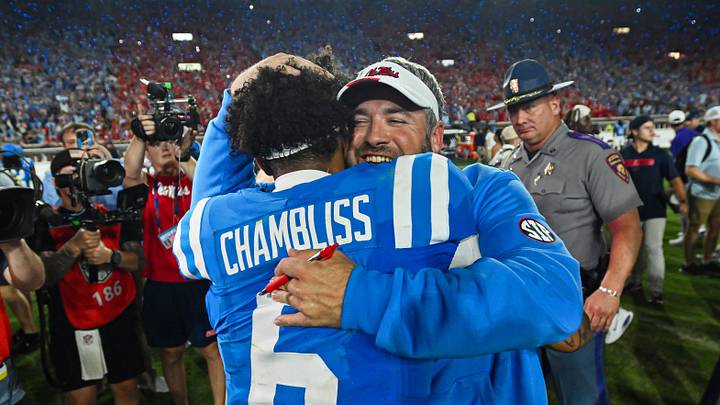
- Ole Miss beat LSU and vanquished the Lane Kiffin ghost.
- Kentucky knocked off Top 10 Texas A&M, and did it convincingly.
- Louisville showed why they might be one of the most underrated teams in the country by knocking off favored SMU.
- Mississippi State completed an incredible comeback at South Carolina, announcing for all the arrival of Kamario Taylor.
Instead of appreciating those games individually, it's incredibly easy to immediately turn them into data points in the playoff discussion.
Somewhere along the way, every college football game became a playoff game
In watching these games, I wasn't rooting for teams anymore. I was rooting for strength of schedule. I wanted to see teams like Louisville and Mississippi State make the playoff committee's job even harder.
And that's where I feel like we, as a collective, have lost the script.
We're barely a month into the season, yet we're already talking about teams being potentially eliminated, quality losses, resumé strength, conference bids, and whether somebody can “afford” another loss.
It isn't that those conversations shouldn't exist. They're fun! We've all participated in them for years. The problem is that they've swallowed everything else and left the purity of watching and enjoying a good game just because it's a good game behind.
September used to give us time to figure out who teams were. Now we're trying to figure out where they belong on a December bracket. We're laying out who gets a playoff bye and who gets a home stadium game before the calendar even flips to October. We're trying to finish the season before we've had a chance to enjoy it.
The expanded College Football Playoff was supposed to make more games matter
There was a time, not so long ago, when a Week 1 loss all but killed your chances at a national championship. Before the playoff, even before the BCS, the pollsters would cross a red line through any name that wasn't boasting a zero in the loss column.
That improved slightly with the BCS, and even more with the 4-team College Football Playoff.
The expanded CFP absolutely does make more teams relevant deeper into the season. That's a good thing. A two-loss team isn't automatically dead. More fan bases can realistically dream about making the postseason.
But there's an unintended consequence of that luxury: When everything matters to the playoff, we start viewing everything through the lens of the playoff.
A September upset isn't simply an awesome upset anymore. Within five minutes, we're asking what it means for the Big Ten's fourth playoff team. When a normally middling Group of Six team starts the season on fire, we're not discussing how great it is to see that program having a tremendous season; we're calculating if they can be an G6 representative in the CFP.
Also Read: College football's golden age is gone and isn't coming back
College football was never supposed to feel this rational
If you wanted rational structure and a certain degree of parity, you tuned into the NFL. College football's fan appeal has always included irrational importance, mostly based in regional tribalism.
Why should beating your rival matter if both teams are 6-5?
Why should people care about winning a trophy shaped like a golden egg, an axe, or an oar?
Why should you spend four hours watching two unranked teams play in October?
Why have a watch party for a bowl game with sparse attendance and zero meaning beyond bragging rights?
Because it's college football, dammit!
Not everything in the sport needs postseason consequences to have meaning. That's what resumé watching threatens to strangle out. It tells us games matter because of what they lead to instead of allowing them to matter because they're happening and they're special.
This coming week is a perfect example: Texas-Tennessee, Ole Miss-Florida, Iowa-Michigan, Oklahoma-Georgia, Texas A&M-LSU, Oregon-USC, just to name a few.
Texas-Tennessee doesn't need to be important because of seeding, it's got the whole Manning family backdrop. Oregon-USC doesn't need to tell us something about the Big Ten's playoff depth, it's a rivalry carrying over from the Pac-12. Texas A&M-LSU doesn't need to be reduced to which team's resumé takes another hit; that's a big-time regional hatefest.
You could watch that slate and spend 12 hours calculating playoff implications and schedule strength. Or you could simply remind yourself, holy crap, that's a fantastic day of college football! Dial up the DoorDash driver!
So this Saturday I'm going to try something. I'm going to stop building resumés. I'm going to watch football. I'll worry about the College Football Playoff when the College Football Playoff gets here (or at least when the rankings shows get here).
Because if every Saturday is only valuable due to what it means in December, we're going to miss an awful lot of what makes September and October great.
 Add us as a preferred source on Google