

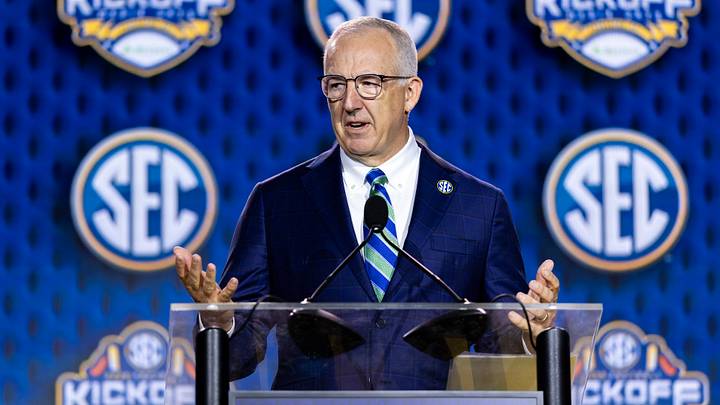
Greg Sankey has dangled the idea of the SEC breaking free of the NCAA's shackles, and while it might have seemed like a "take my ball and go home" statement before, we may be approaching the time when he needs to turn that seemingly idle threat into a reality.
The idea of expanding the College Football Playoff to 24 teams -- insane as it may be -- is likely a reality, and it's something the SEC and Greg Sankey have been kicking and screaming against. But the latest update should give Sankey the motivation to act.
Today’s meeting of the College Football Playoff leaders produced no decision or vote, but discussion included a 24-team playoff, logistics, and potential buyouts of conference championship games.
Those last five words should give Greg Sankey not only a reason to pause, but genuine concern.
The "old" college football isn't coming back, and we know that. But apparently, the next step in improving college football is figuring out how much to pay college football to stop being college football.
CFP leaders are closer than ever to expanding to a 24-team playoff. They are talking buyouts of conference title games and scheduling logistics of doubling the field.
— Ross Dellenger (@RossDellenger) September 30, 2026
Foregone conclusion?
“If we can get a decent (TV) deal, we are definitely going to 24.”https://t.co/pm99bNu4D9
The SEC Championship Game in Atlanta should be the line in the sand
24 playoff teams is a nuisance of an idea. All but killing off the bowl season is abhorrent. But ending the conference championship games, in particular, the granddaddy of them all -- the SEC Championship Game -- is pure blasphemy and should become the place where Greg Sankey digs his heels in and says, "Enough!"
The SEC championship is an achievement fans can value independently of a national title. It has meaning and value beyond just the potential entry into the playoff field. The SEC was the first to have such a game, and the rest of college football eventually chased that idea. There's a reason for that.
A season of conference competition leads to a game with a clear reward: Win it, and you’re the SEC champion. Eliminating that game to accommodate a larger invitational makes the conference season serve the postseason bracket.
So what is Sankey protecting if that championship becomes expendable?
Greg Sankey has talked about leaving. What exactly is he waiting for?
During his opening remarks at this year's SEC Media Days, Sankey remarked that there had been "real" conversations about whether the league should break away. "People have talked about that," Sankey said. "The frustrations that bring them to the point of saying we should look at something significantly different. I do not believe that is a leverage point. I think that's honest communication."
Those conversations concerned the SEC’s place within the NCAA, not a departure from the playoff. But if Sankey is willing to consider changing who governs his conference, he should be willing to reconsider who controls its postseason.
Would independence be consequential? Absolutely. But it would also be liberating.
If sacrificing the SEC Championship isn’t sufficient reason to act, what would be? The threat to leave loses some force when you keep asking where the next meeting will be held.
Now in truth, the SEC is partially to blame, but shouldn't continue to be complicit. Sankey has had a role in CFP expansion, conference consolidation, and lobbying for postseason access. Greg Sankey helped to build a system that he now has to navigate his way out of.
That history gives the SEC Commissioner a responsibility to draw a boundary for the good of the conference. Mitigate any further damage by finding a path to independence.
A self-contained, independent SEC would bring a lot of advantages
When you think about what's been lost in the hurry to build a bigger playoff and to toss aside the traditions that have made college football special, it's easy to build a list of what could be gained by moving away from the mothership. By standing on its own, the SEC could:
- Run its own conference season under its own rules.
- Preserve meaningful rivalries and a championship game.
- Crown its champion through results rather than an invitation.
Let the remaining FBS choose its postseason format and determine its winner. Sure, independence will require surrendering the expectation that the SEC will have CFP berths. So be it. We surrender. We also have control and will accept those consequences.
Yes, this would divide the sport further, but a split like this would be preferable to losing the most meaningful championship game in the sport outside of the national championship. Keeping that game is a far better option than accomodating continued playoff expansion.
I know that question you're asking, Mr. Sankey. "What then?"
I give you the Super Bowl of College Football
Quite simply, we run it back to the origins of the NFL's Super Bowl. The AFL vs. the NFL for all the marbles. The old guard versus the upstart league; only this time, instead of bringing two leagues together on their way to a merger, this one would bring their champions together after a split.
The SEC champion plays the winner of the eventual College Football Invitational (you know, that thing we now call the College Football Playoff). The agreement between the sides would be that each side controls its competition, and their champions meet for the true national title.
SEC vs FBS...the National Championship Bowl...or perhaps the "Told You So" Bowl would be appropriate?
Why would the rest of college football agree? Because both sides would have a championship to sell, and then one more game neither could stage alone. The SEC would get its independence. The Invitational would get its sprawling bracket. Television would get the kind of grudge match it usually has to manufacture.
The world against the SEC, just like it always was, and should always be.
The choices are clear. Pursue independence, or keep negotiating and giving way to the ever-expanding playoff and the reduction of regular-season meaning. Greg Sankey should stop threatening the former if he will always accept the latter.
The onus is on Sankey to make this happen and protect the SEC from further predation. Keep the SEC title game in Atlanta and protect it at all costs.
If Atlanta isn’t worth walking out over, Greg, stop telling us you know where the door is.
 Add us as a preferred source on Google