

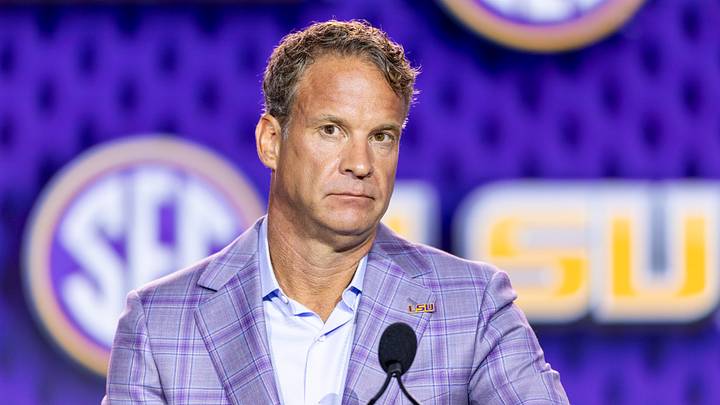
Is Lane Kiffin recklessly testing how far he can push college football's rules, or is he simply better than everyone else at recognizing that the rules don't mean much until somebody can actually enforce them?
LSU and its head coach have been aggressively pursuing former pros, and then abstained when the other 15 SEC schools approved a penalty structure for using those players. Meanwhile, officials from those other member schools are discussing everything from probation and competition boycotts to litigation and even LSU's expulsion from the conference
This isn't surprising, or an unexpected tactic in the least. Kiffin has spent years being college football's most cunning exploiter of change and lack of oversight. He plays the villain with a kind of twisted joy.
- The Transfer Portal opens. Lane attacks it harder than everyone else.
- NIL changes how rosters are constructed. Lane adapts and spends all the money.
- Rules permit something everyone considers shady or distasteful. Lane doesn't care about appearances.
- A court ruling creates another potential talent pool. Lane breaks out the checkbook and scans the NFL waiver wire.
That, with all its displeasure and irritation, is part of what makes him Lane Kiffin.
But there's a tremendous difference between annoying rival coaches -- something Kiffin seems to relish -- and having 15 fellow conference members discuss whether they should refuse to play you or even kick you to the curb entirely.
At some point, competitive aggression and social media sniping becomes an institutional risk.
Lane Kiffin has spent years daring college football to tell him no; now someone finally might
The biggest problem with this entire scenario is that LSU has a really talented football team that can contend without this circus. There are some fine lines of competition between the players LSU has and the ones Kiffin wants to bring in. It is truly a calculated risk.
But once the SEC responds with a rule that carries a potential half-season suspension for the head coach and a financial penalty equal to half the sport's operating budget, and fellow members start discussing even more extreme action, the calculation should dramatically change.
How much better do Dae'Quan Wright and Zxavian Harris make LSU? Is the talent gap big enough to risk your new (and highly paid) head coach for half the season? Is it enough to risk a war with the SEC or to add an added distraction mere days before playing Clemson?
Truthfully, it doesn't seem like enough to potentially jeopardize a roster that's already good enough to compete for a championship.
This may be a case where Kiffin needs to understand that no means no, and even with a local court ruling, he should nod in agreement, put those court rulings in his pocket for potential bargaining chips down the road, and go coach his football team as it's built.
What happens when Kiffin becomes so convinced he's the smartest guy in the room that he stops recognizing when the room has turned against him?
Kiffin has built a reputation around finding every advantage available to him, exploiting every roster-building device, and being absolutely unapologetic about it. And frankly, that's his job. If Rule 4.7.2 says he can do something that helps LSU win, he isn't paid millions to voluntarily follow some imaginary Rule 4.7.3 titled “Yeah, but that feels kind of shady.”
But everyone who pushes the envelope eventually finds that edge where they've gone too far. Kiffin may have finally found that edge.
Kiffin is the college football version of Icarus, but the problem with flying close to the sun isn't that you're guaranteed to fall. Sometimes you discover everyone else was simply afraid to fly that high. Lane Kiffin has made a career out of proving that, but you only have to be wrong once for the wings to melt.
 Add us as a preferred source on Google