

The 2025 season was an absolute horror show for the Michigan State Spartans. After a promising 3-0 start to the campaign — thanks in large part to a favorable non-conference slate featuring Western Michigan, Boston College, and Youngstown State — the Green and White already appeared halfway to bowl eligibility.
Then, the anvil dropped.
Big Ten play began, a disastrous 1-8 conference showing followed, and the Jonathan Smith era ended almost as quickly as it started. Smith was dismissed just hours after the Spartans’ season finale against Maryland.
But that was last year.
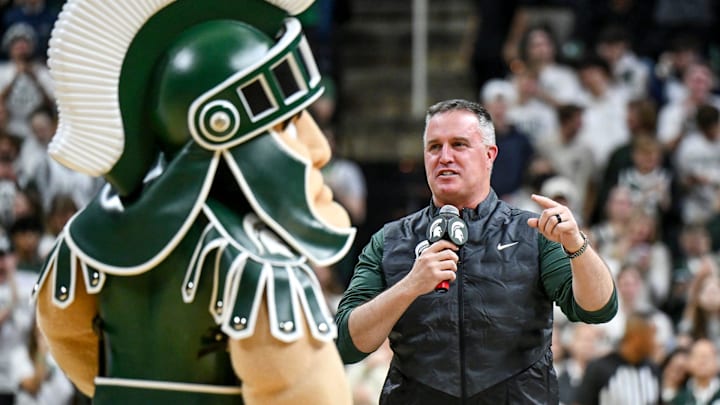
Now, in 2026, a new era has dawned on the banks of the Red Cedar with the appointment of Pat Fitzgerald as head coach. Once considered one of college football’s brightest coaching minds — guiding his alma mater Northwestern to two Big Ten West championships — Fitzgerald arrives in East Lansing seeking a second chance after his unceremonious departure from the Wildcats in the summer of 2023.
Fitzgerald was fired amid the sexual assault allegations surrounding Northwestern’s football program. However, he was also facing mounting pressure on the field, as the Wildcats posted a combined 4-20 record over the final two seasons of his tenure.
Which begs the question: will the once-proud Michigan State football program actually improve under Pat Fitzgerald? And if so, what does “better” realistically look like in 2026 and beyond?
The answer is unequivocally yes. While the Spartans’ brass may not have hit a home run with this hire on paper — especially compared to some of the splashier names brought in by programs such as Auburn, Florida, LSU, Oklahoma State, and UCLA — Michigan State undoubtedly hired one of the most experienced coaches available.
Ups and downs are expected at a program like Northwestern — and frankly, more downs than ups. Yet Fitzgerald still produced nine winning seasons across 17 years with the Wildcats, including two 10-win campaigns and the aforementioned pair of Big Ten West titles. That résumé makes it clear that Fitzgerald is a high-quality football coach.
Fitzgerald’s developmental track record fits Michigan State’s identity
More importantly, Fitzgerald has consistently shown an ability to identify overlooked talent and develop those players into quality collegiate performers. His teams were also known for their physicality and competitiveness. Fitzgerald’s players were tough-nosed and disciplined, traits that align closely with Michigan State’s most successful era under Mark Dantonio.
Needless to say, it feels almost inevitable that Michigan State will rise from the Big Ten basement it occupied a season ago.
As for the 2026 roster outlook, Fitzgerald assembled a recruiting class of 50 players, consisting of 21 high school recruits and 29 transfers. According to 247Sports, Michigan State ranked 48th nationally and 12th in the Big Ten in the overall recruiting rankings — including 45th nationally in high school recruiting and 56th in the transfer portal rankings.
Offensively, notable additions include wide receivers KK Smith from Notre Dame and Fredrick Moore from Michigan, running backs Cam Edwards from Connecticut and Jazuin Patterson from Iowa, plus offensive linemen Ben Murawski from Connecticut, Trent Fraley from North Dakota State, and Nick Sharpe from South Carolina.
Defensively, key newcomers include defensive linemen Eli Coenen from Illinois and Kenny Soares Jr. from NC State, linebackers Dion Crawford from Buffalo and Caleb Wheatland from Auburn, as well as defensive backs Tre Bell from Iowa State, Charles Brantley from Miami (FL), and Michael Richard from Louisiana Tech.
While it’s certainly an eclectic collection of transfers — indicative of the wide range of programs these players are arriving from — the class also highlights Fitzgerald’s long-standing strength: finding and developing undervalued talent.
A manageable schedule could lead Sparty back to a bowl game
As for the schedule, it’s actually fairly forgiving by Big Ten standards. Michigan State avoids Indiana, Ohio State, Penn State, and USC altogether.
Without question, games against Michigan, Notre Dame, and Oregon will be daunting challenges. However, much of the remaining schedule feels winnable, or at the very least competitive.
Because of that, I’m expecting Fitzgerald’s Spartans to reach at least six wins and return to bowl eligibility for the first time since 2021, when Michigan State defeated Pittsburgh 31-21 in the Chick-fil-A Peach Bowl en route to an 11-2 season.
Beyond 2026, the ceiling for Michigan State under Fitzgerald could be surprisingly high. For the first time in his head coaching career, Fitzgerald will have access to the kind of athletic department resources Northwestern simply could not consistently provide.
If Fitzgerald was capable of winning 10 games at Northwestern, why can’t he eventually accomplish the same — or more — at Michigan State? It may sound far-fetched today, but if the Spartans regain their developmental identity and physical edge, a future College Football Playoff appearance may not be out of the question for Sparty.
 Add us as a preferred source on Google