

This is only Year 2 of the 12-team College Football Playoff. That important to remember as the college football world inevitably overreacts to the results. Last year, the CFP rightfully corrected its seeding structure, removing automatic byes for the four-highest-ranked conference champions. If that didn’t happen, Tulane would be getting prepared to play Ohio State on New Year’s Day.
This year, the instinct will be to overreact to the inclusion of two Group of Six teams because Tulane and James Madison made for a boring Saturday. But we should be careful not to punish the G6 for the ACC’s faults. If the ACC had tiebreakers that made sense and prioritized Miami getting into the conference title game over five-loss Duke, we wouldn’t have been in this mess.
The 12-team format isn’t perfect, but we have a quarterfinal with No. 5 Oregon vs. No. 4 Texas Tech at the Orange Bowl, No. 9 Alabama vs. No. 1 Indiana at the Rose Bowl, No. 6 Ole Miss vs. No. 3 Georgia in the Sugar Bowl, and No. 10 Miami vs. No. 2 Ohio State at the Cotton Bowl. I can bear a weekend like this if that’s on the other side.
First Course
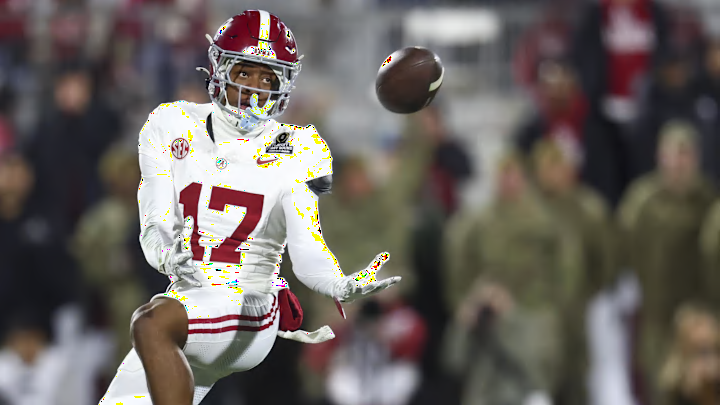
1. A taste of Brent Venables' own medicine (No. 9 Alabama 34 No. 8 Oklahoma 24)
If it’s not “Dr. Heat” himself, Gregg Williams, Brent Venables might be the patron saint of pressure. Venables not only blitzes as much as anyone in college football, but he has as many unique pressure packages and simulated pressure looks as anyone in the sport. That, along with a dominant defensive line, led the Sooners to be the No. 2 defense in the country by adjusted EPA/play heading into the CFP.
A steady diet of blitzes, especially after building a 17-0 lead by holding Alabama to 12 total yards on its first three drives combined (all three-and-outs), helped Venables limit the Tide to 260 total yards of offense and a 31 percent success rate. Offensive coordinator Ryan Grubb and the Alabama offense have a few interesting counterpunches, and Oklahoma’s special teams gaffes opened the door for a comeback, but a 17-point comeback isn’t possible for the Tide without finding a way to get stops. Alabama defensive coordinator Kane Wommack’s answer, after allowing points on three of Oklahoma’s first four drives, was to give Venables a taste of his own medicine.
Alabama came into the CFP blitzing at the lowest rate in the SEC (15 percent). All season, Wommack has lived with four-man pressures, split-field safety looks, and zone coverage to keep things in front. This forces offenses to take what’s there, not get greedy, and avoid a big mistake. Through the first quarter and a half, that’s exactly what John Mateer did.
So, rather than let his defense be paper-cut to death with LT Overton, one of its premier pass rushers, while Alabama’s offense flailed, Wommack turned up the heat. It was a real risk against an inconsistent quarterback like Mateer, but one with a knack for creating explosive plays, especially to wide receiver Isaiah Sategna, and it paid off big time.
Wommack played more single high safety, and added pass rushers to finally break a young Oklahoma O-line, which was playing surprisingly well early. He finished with a 41.2 percent blitz rate on Mateer, up from 18.5 percent in the Week 12 Oklahoma win, and on those 21 blitzed dropbacks, Mateer managed just 3.1 yards per attempt with a 30 percent pressure-to-sack rate. When pressured in the game, Mateer averaged 1.4 yards per attempt compared to 8.7 when kept clean.
Mateer looked the healthiest he’s been since breaking his hand midway through the season. Yet, his feet are still a big issue. Mateer’s feet aren’t tied to his eyes in the pocket, so as he clicks through his progressions, his footwork lags behind the rest of his body, forcing him to throw from awkward platforms even when he has time in the pocket. When that internal clock speeds up, that problem certainly doesn’t get better, and it leads to far too many inaccurate throws and even a crucial pick-six before the half.
Alabama is still not a sound tackling team. Their run fits continue to be sloppy, and they lack an elite pass rusher. But this was an impressively called game from Wommack, even though Oklahoma’s anemic offense managed 24 points, and could have had 30 if it weren’t for two missed field goals from the Lou Groza Award winner.
Second Course
2. Miami survives a slopfest (No. 10 Miami 10 No. 7 Texas A&M 3)
How do you win a game when you post a 27 percent success rate, a 4 percent explosive play rate, a quarterback with -0.49 EPA/dropback, and a kicker who missed three of four field goal attempts? You get 10.3 points of turnover luck with a +2 turnover margin despite both teams finishing with 1.4 expected turnovers. That’s what Miami needed to overcome Texas A&M in College Station. It also needed a special player to make a special play.
After a fourth-quarter fumble on the cusp of field goal range, Malachi Toney scored the game’s only touchdown on a jet sweep. Toney was far from prolific, but the true freshman wide receiver delivered in the clutch after a parade of designed touches went for next to nothing all day.
That’s what Miami needed because neither Carson Beck nor Marcel Reed were up for the moment. The wind, which was gusting around 30 miles per hour all day, had an impact, but even in perfect conditions, neither quarterback has performed well against top competition this season. Beck was wildly ineffective, but he avoided the turnovers that cost Reed, including a back-breaking pick in the end zone with 24 seconds. He’ll need to do more than just not give the ball away against Ohio State.
Third Course
3. No Lane, no problem (No. 6 Ole Miss 41 No. 11 Tulane 10)
I can’t say I have any interest in re-litigating the Lane Kiffin saga. Kiffin dragged that out long enough already. However, it’s impossible to evaluate this game without mentioning that Kiffin is at LSU, Pete Golding is Ole Miss’s new head coach, and Charlie Weis Jr. is back with the Rebels to call the offense throughout the College Football Playoff.
With the reshuffled coaching staff, at least against Tulane, the offense looked the same. After a 45-10 win in Week 2 of the regular season, the Rebels rolled to a 41-10 win in Oxford on Saturday. Weis’s unit was nearly as efficient, and though the defense gave up significantly more yards, that’s understandable considering Week 2 was Tulane quarterback Jake Retzlaff’s second start after transferring to Tulane in the summer.
In the regular season, the Green Wave offense finished with a 38 percent success rate and -0.15 EPA/play. Retzlaff threw for 56 yards on 5-for-17 passing. On Saturday, Retzlaff threw for 306 on 20-for-36 passing, and Tulane produced 0.03 EPA/play with a 46 percent success rate. Those are two wildly different performances to arrive at 10 points. It was made possible by Ole Miss holding Tulane to a zero percent success rate in the red zone.
Potentially, that ‘bend don’t break’ mindset in the red zone is masking a defensive drop off with Golding taking on additional responsibilities. Potentially, Tulane just made significant offensive strides since Week 2. The good news is that we’ll get another data point because the Rebels have another rematch, this time with Georgia, in the Sugar Bowl CFP quarterfinal.
Head of the table: The best individual performance earns the seat at the head of the table
4. Alabama WR, Lotzeir Brooks (No. 9 Alabama 34, No. 8 Oklahoma 24)
Ryan Williams has unexpectedly faded into irrelevance down the stretch of his sophomore season for Alabama, but the Crimson Tide aren’t without talented pass catchers. Despite playing just 24 snaps, Lotzeir Brooks, the latest true freshman breakout star, has emerged in massive spots for Ty Simpson.
Down 17-0 in the second quarter, Kalen DeBoer left his offense on the field. Venables brought a blitz, and Simpson had no reservations about trusting the freshman to come through. Brooks didn’t just move the chains; he contorted his way into the end zone and sparked the comeback win.
True freshman Lotzeir Brooks SPINNING his way into the endzone 🔥 pic.twitter.com/UCf9Ut4i0C
— ESPN (@espn) December 20, 2025
Brooks finished with five catches for 79 yards and two touchdowns on seven targets. Brooks’s 4.65 yards per route run was the highest of the playoff and the third-highest single-game yards per route run of the entire season for players with at least five targets. That’s an absurdly efficient game, especially considering the stakes.
Appetizers: A little something to chew on from the week that was in college football
5. Not so special teams (No. 9 Alabama 34 No. 8 Oklahoma 24)
Teams that win with defense rarely ever just win with defense. Often, to win that way, teams have to also be excellent in the third phase of the game. That’s one of the reasons that Oklahoma beat Alabama in Week 12.
In that one, Lou Groza award winner, Tate Sandell, hit three field goals, including one from 52 yards, while Alabama had an 18-yard attempt blocked, and the Sooners had an average starting field position at their own 46-yard line. They managed 23 points despite never having a drive of 50 yards. That’s great defense, but it’s also great special teams.
The rematch in Norman started the same way, with Oklahoma dominating the field position battle as it built a 17-0 lead. Then, everything flipped. Sandell, by far the most valuable kicker in the sport by CollegeFootballData’s points added above replacement metric, missed two of his three field goal attempts, including his first miss from 50+ all season. The best kicker in college football finished with a -6.41 total kicking EPA, and despite positive EPA punting and kick returning performances, Oklahoma ended the game with -5.08 special teams EPA.

To make matters worse, Oklahoma had a punt blocked, which led directly to an Alabama field goal, part of a run of 24 unanswered points for the Tide. You can win games with defense, but you need great special teams units to do it. Oklahoma did all season, but its special teams weren’t special on Friday night.
6. Miami's downhill run game (No. 10 Miami 10 No. 7 Texas A&M 3)
Miami primarily operates out of the shotgun, which can be a difficult way to run the ball without a run threat at quarterback. So, offensive coordinator Shannon Dawson put Carson Beck in the pistol to get a downhill run game against Texas A&M. That’s particularly effective against a defense like A&M that relies on stunts and exotic blitz packages to pressure the quarterback.
Missouri, primarily a pistol offense, especially in Week 11 with true freshman Matt Zollers at quarterback, ran the ball for 207 yards against the Aggies. Now, this wasn’t a skeleton key for Miami. The Canes managed a 28 percent rushing success rate and only one explosive play on the ground. Still, the biggest play of the game, which set up the only touchdown of the game, came on a downhill run out of pistol, and in a windy game with four missed field goals, one big play was enough.
UNBELIEVABLE RUN pic.twitter.com/znJHLxaEX8
— CFB Kings (@CFBKings) December 20, 2025
Dessert: Whether it’s a rich play design or a decadent athletic display, here’s a sweet football treat
7. Ryan Grubb was up to his old tricks (No. 9 Alabama 34 No. 8 Oklahoma 24)
When John Mateer got happy feet in the second half and started missing open receivers, Ty Simpson settled in against Venables’ exotic pressure looks and started making NFL throws. One of those throws was to Isaiah Horton, his big jump ball wide receiver, but the opportunity was created by one of Ryan Grubb's favorite formational tricks.
Early, Kalen DeBoer and Grubb asked Simpson to play chess at the line of scrimmage with Venables, making protection checks to counter the complex defensive looks and disguises. For as cerebral as Simpson has proven to be in his first year as the Tide’s starting quarterback, that’s a huge ask for any college quarterback. The strain was only heightened by Alabama’s propensity to operate out of condensed sets, which makes it easier for defenses to blitz corners and safeties because they don’t have as far to go.
So, in the second half, Grubb went to more spread looks to force Venables to declare his intention pre-snap. And, to create one-on-ones for Alabama’s talented group of wide receivers. When Grubb goes spread, rather than have the strength of the formation or a bunch set into the field, giving the three receivers (or two receivers and a tight end) the additional space to work with.
Instead, Grubb loves to run bunches into the boundary. That gives his X receiver on the backside, the entire field to create separation, and puts deep safeties in a bind because they’re reluctant to shade toward a single receiver side pre-snap.
It was a trick that Grubb used to great effect at Washington with Rome Odunze, and he repurposed it a few times on Friday night. It always makes it easier on his quarterback to just play matchups and get the ball out quickly. It’s excellent play-calling and in-game adjustments. Still, it helps to have a quarterback who can make a throw like this.
ISAIAH HORTON, WHAT A GRAB! 🧤 #CFBPlayoffs pic.twitter.com/I9Kzx5JY0P
— TSN (@TSN_Sports) December 20, 2025
8. The 12 (personnel) days of Christmas (No. 5 Oregon 51 No. 12 James Madison 34)
Oregon has unlocked an offensive superpower with its 12 personnel grouping(1 running back, 2 tight ends), and it exploited it from jumpstreet on Saturday night in Eugene. With two tight ends on the field on its first drive, Kenyon Sadiq and Jamari Johnson, James Madison, terrified to get run on by only the second Power 4 opponent it faced all season, matched with base (4 defensive linemen and 3 linebackers). Immediately, Oregon offensive coordinator Will Stein smelled blood in the water.
On the third play of the drive, Dante Moore threw out of 12 personnel, completing a 14-yard pass. Then, recognizing his advantage, went no-huddle and didn’t substitute, which forced JMU to stay in base. Moore split Saddiq out wide, forcing a one-on-one with a cornerback and creating a one-on-one in the opposite slot for 6-foot-5, 257-pound Jamari Johnson against 6-foot, 234-pound linebacker Trent Hendrick. It went about how you’d expect.
OREGON COMES OUT THE GATE PUNCHING 😱
— TNT Sports U.S. (@TNTSportsUS) December 21, 2025
Jamari Johnson with the reception and TD as @oregonfootball scores first on TNT, truTV, TBS & HBO Max 👀 pic.twitter.com/rwmEKDdnOq
As long as teams insist on matching Oregon’s 12 personnel with base, the Ducks will feast in the explosive passing game.
A new recipe: With their season over, these eliminated teams need to cook up a new recipe this offseason
9. Oklahoma
The question of Oklahoma’s offseason is simple. Did John Mateer fall off after Week 4 because of his hand injury, or is that just who John Mateer is? How Brent Venables and general manager Jim Nagy answer that question will determine how they proceed this offseason and whether or not they need to go back into the transfer portal for a quarterback.
Personally, I’m not a Mateer fan. I think his accuracy issues stem from his footwork, not his hand injury, and his health had nothing to do with his poor decision-making. However, considering the top of the market is going to be around $5 million for a transfer portal quarterback, and there aren’t many players in the portal right now who are surefire upgrades, I’d run it back with Mateer and Arbuckle, hope one of the youngest offensive lines in the country improves, and spend real money on a running back, ideally Florida’s Jadan Baugh hwo will enter the portal.
I’m not typically going to be one to advocate for spending up on a running back. I generally believe that in college football, as in the NFL, running games are made by offensive lines and play-callers, and backs only affect the degree to which you have success, not whether or not you have it. Yet, in this case, for a team built around its elite defense that would love to play ball control and protect a somewhat erratic quarterback. Having a bellcow back, like Oklahoma attempted to add when it took Jadyn Ott from Cal in the spring portal window, would go a tremendously long way.
10. Texas A&M
There is more to roster building than just quarterback decisions, but it’s undeniably the most important position, and Texas A&M, like Oklahoma, faces a real conundrum with its incumbent starter. However, unlike the Sooners, the Aggies don’t have their play-caller coming back as Colin Klein was hired away to be the head coach at Kansas State.
To me, that opens the door a bit more to make a change, as does A&M’s position as one of the sport’s preeminent NIL spenders. Sure, spending $5 million on a transfer portal quarterback isn’t a great idea if that $5 million is coming exclusively from your $21 million revenue-sharing cap. But the reality is, the cap isn’t real, and if a team is operating as though it is real, that team is not trying to win. In College Station, that $5 million is out of somewhere closer to a $40 million budget when you factor in NIL spending.
To call the Aggies fraudulent is probably a bit disingenuous, but they played an SEC schedule that featured the bottom five teams in the SEC, and against Power 4 opponents, Reed threw 15 touchdowns to 12 interceptions. This season was a massive success, but Mike Elko shouldn’t trick himself into believing his team was closer to a title than it was, and definitely shouldn’t trick himself into believing that Reed is a top-of-market quarterback. It may take $5 million for a top transfer, but it’ll probably take at least three to keep Reed.
11. Tulane
Jon Sumrall is heading to Florida, so the big question for Tulane’s offseason is which players will be following him to Gainesville. With Sumrall hiring two new coordinators, Buster Faulkner from Georgia Tech and Brad White from Kentucky, this may not be a case where the entire roster is gutted for new head coach Will Hall. Star defensive lineman Santana Hopper has already announced his intention to enter the transfer portal, and he certainly won’t be the last.
12. James Madison
Bob Chesney is off to UCLA, but Billy Napier, making his triumphant return to the Sun Belt, is a strong enough recruiter to keep the Dukes at the top of the conference. The most important thing with Napier, though, is that he should not be the team’s offensive play-caller. Napier’s offenses at Florida were disjointed, and he clearly stunted DJ Lagway’s growth this season. Maybe that doens’t matter at the G6 level, but maybe it does. Napier should swallow his pride and hire a play-calling OC, but I wouldn’t hold my breath waiting for it.
 Add us as a preferred source on Google