

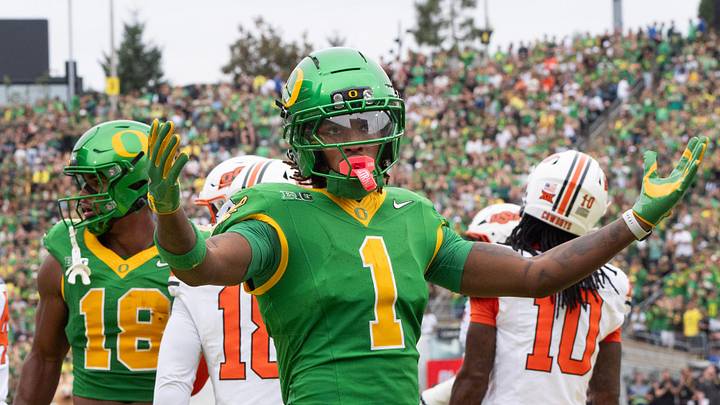
The other day, I did a dive on the 2026 Oregon Ducks—specifically their schedule—and came to the conclusion that they were not as secure of a lock for the playoff as many would hurriedly assume…and boy, did I catch some heat for that.
Next thing I knew, my name was being tossed around some Oregon-worshipping forum as Ducks from all over ripped me to shreds like bread in a pond. A primary reason for the ripping? I didn’t take into account Oregon’s roster.
Now there is a reason for this: the purpose of offseason pieces like mine is solely to establish a general assessment of how I expect teams to do if schedule is any indication, and that’s a perspective best substantiated by how everyone did last season. Therefore, it’s clearly not meant to come off as some OFFICIAL, HARD-NOSED RECORD PREDICTION—merely a schedule analysis to get your brain ticking, along with perhaps scratching a football-longing itch.
Especially when it comes to programs like Oregon, the mention of a roster holds no significance in said analysis, as thanks to both its coaching and consistent success, the idea of there being a tectonic shift in its talent is laughable on a good day.
Another factor, however, is Oregon’s unjustifiable tendency to lose games it shouldn’t (in a fashion it shouldn’t) late in the season, which brings me to the hard truth that apparently still needs sharing: the practice of getting hung up on a team’s roster has never been more foolish than it is in this era of NIL and the transfer portal! I mean for crying out loud, do you remember the season we just had?
To put it simply, all the "good" teams did bad and all the "bad" teams did good. Think that’s an exaggeration? The SEC, who has long held the yearly bragging rights for most NFL draft picks, saw its appearance drought in the national title hunt extend to what is now three seasons in a row.
Meanwhile, Indiana just went 16-0 and won the natty, Vanderbilt went 10-3 with a Heisman finalist at QB, Wake Forest went 9-4 with a bowl win, and even Iowa State hit the eight-win threshold again. We also saw SMU continue to hold its own as one of the ACC’s best, and a five-loss basketball school win that very same conference. Where does a roster’s on-paper status come into play for any sizable part of that long, chaotic list?
I’m obviously not saying that roster conditions never hold importance in a CFB conversation, as I myself am not beyond referencing them. But when I do, especially in an offseason context, I weigh their concreteness very lightly, being on par (at best) with that of a schedule or the season prior—and until this sport returns to anything resembling normalcy, I feel no obligation to scrap that approach.
 Add us as a preferred source on Google