

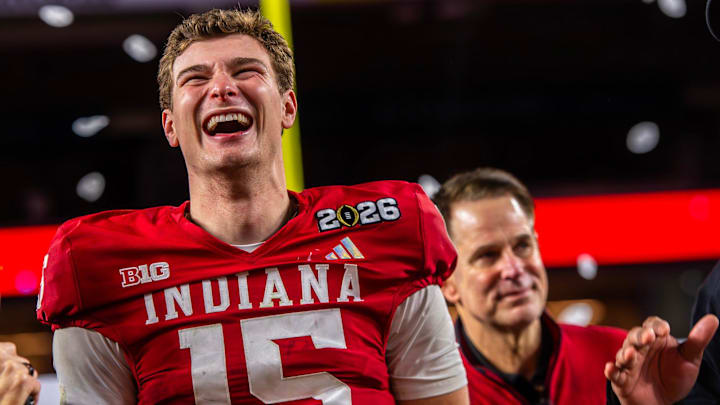
The program that entered the year as the losingest in college football history just earned itself a seat at the big kids' table. With Monday night’s 27-21 win over Miami, Indiana became the first program to win its first-ever national championship since Steve Spurrier led Florida up the mountaintop in 1996. Not Oregon with its Phil Knight money, not Texas Tech with the backing of oil barons, but Indiana.
It wasn’t as resounding as his previous two College Football Playoff wins, or as many would’ve expected, and it will certainly exempt them from conversations with 2019 LSU about the greatest team of all-time, but who cares? The Indiana Hoosiers are the first 16-0 team in college football since the 1894 Yale Bulldogs, and more importantly, they’re national champions.
So, let’s dig into our final meal of this college football season and savor every bite.
First Course
1. Fourth-down fearlessness (Indiana 27 Miami 21)
When Curt Cignetti arrived in Bloomington, taking over the losingest program in college football history, he understood what it would take to steal a bit of national attention. He had to be brash, he had to be bold, and he couldn’t back down. Luckily, two years after he told the media, “I win, Google me,” and proclaimed that “Purdue sucks and so does Michigan and Ohio State,” it’s clear that brash and bold aren’t anything out of the ordinary for Cignetti.
On Monday night, he joined Michigan and Ohio State as national champions, continuing the Big Ten’s run of dominance in the NIL and Transfer Portal era. And while he’s dialed back on the brashness now that he’s on top, leading the No. 1 team in the country to an undefeated 16-0 season, he held on for a 27-21 win over Miami because he was bold, because he didn’t back down, and because the entire Indiana program is fearless.
It’s easy to send caution to the wind when you’re the hunter. It’s different when you’ve weaseled your way into conversations with 2019 LSU and enter the National Championship Game as a 7.5 point favorite. So, Curt Cignetti needed a couple of timeouts to remind himself to stay aggressive on fourth down on what would prove to be the game-winning touchdown drive.
First, he called a timeout facing a fourth-and-5 at the Miami 37, an easy decision up three staring down what would have been a 54-yard kick for Nico Radicic, whose career-long is 46 yards. And finally, undaunted by Miami’s sticky coverage and an utter lack of pass interference flags throughout the game, Mendoza finally connected on a back-shoulder throw for 19 yards to Charlie Becker.
Then came the tougher call. Should it have been tough? Probably not. There isn’t much value in making a one-score game a one-score game with 9:27 left in the fourth quarter, but fourth-and-4 is a long way against a defensive line that was eating Indiana’s tackle alive all night. So, get them going upfield. Get Mario Cristobal and Corey Hetherman to put their pass-rushing package on the field with light bodies, and run your 6-foot-5, 225-pound Heisman Trophy-winning quarterback right at them.
FERNANDO. MENDOZA.
— ESPN (@espn) January 20, 2026
THE PLAY OF A LIFETIME ‼️ pic.twitter.com/g3o5nNNslr
Mendoza, who had been battered all night, sure didn’t run scared when his number was called. He delivered a play that will live forever, born out of a decision to be fearless, built on a head coach who was unafraid to dispel every myth about what it takes to win in college football.
Second Course
2. Miami’s D-line dominance (Indiana 27 Miami 21)
There was one path to Miami winning this game, and considering the Canes lost by six in a game when they doinked a field goal and had a punt blocked for a touchdown, they got about as close as possible. That path was for Cristobal’s team, which was built to dominate everyone on both lines of scrimmage, did exactly that.
On the offensive side, Miami produced a 48 percent rushing success rate, and Carson Beck was pressured on just four of his 33 dropbacks and sacked just once. Indiana’s quickness along the front allowed the Hoosiers to penetrate against the run, at times, and their commitment to playing base defense allowed their three linebackers to help fit the run, especially on short yardage downs, but Miami won the battle. On the defensive side, the beatdown was worse.
Rueben Bain Jr. is a surefire top 10 pick in the 2026 NFL Draft, and if Akheem Mesidor hadn’t locked up a spot in the first-round, the sixth-year senior did on Monday night. The duo wrecked the Indiana passing attack all night. The Miami defense pressured Mendoza 11 times, sacked him three times, two from Mesidor and one from Bain, and on his 10 dropbacks over 2.5 seconds, Mendoza finished 2-for-5 for 13 yards with three sacks and two scrambles. He was running for his life.
Rueben Bain Jr with a Pass Rush matchup against Indiana RT Kahlil Benson, who was called for one of the three holds he committed on the play, pushing the Hoosier backwards on their second possession.#Indiana #miami #CFBPlayoff #NationalChampionship pic.twitter.com/puo0KkuYSj
— All 22 Films (@All_22_NFL_Cuts) January 20, 2026
It was so bad that Indiana had to bench its senior right tackle, Khalil Benson, at halftime for Adedamola Ajani, after the longest holding penalty of all-time. And to kickstart the run game, they went to 16 snaps with a sixth offensive lineman, Zen Michalski, a season high for Indiana’s swing tackle in a six OL look. And Carter Smith, the Hoosiers’ second-team All-American left tackle, didn’t have a great night either.
Rueben Bain showed once again last night why he’s one of the best player in this class. He not only recorded a sack, but was also a disruptor in the run game pic.twitter.com/pNgDe5IHmt
— Prospect Film Room (@FilmProspect) January 20, 2026
Indiana was already one of the highest RPO-rate teams in the country this year, and they had to ramp that up even further against Miami. And the Canes, especially once defensive back Xavier Lucas returned in the second half after serving his targeting suspension, had an answer for IU’s counterpunch, one that very few other teams have been able to muster.
Second helping:
3. They can’t call them all–or at least they probably won’t (Indiana 27 Miami 21)
Because Indiana offensive coordinator Mike Shanahan relies so heavily on the RPO passing game, defenses can’t afford to sit in zone coverage against the Hoosiers. Mendoza is too good in the quick game and will carve them to death. He did to Miami through much of the first half without Lucas on the field.
So, once Indiana gets you playing press man to take away the quick game, it’s typically bombs away. Cignetti has built a massive receiving corps, punctuated by 6-foot-2, 209-pound Elijah Sarratt and 6-foot-4, 204-pound Charlie Becker, who are both contested catch experts.
Once they see man coverage, it’s slot fades, and back shoulder throws all day. Against Oregon in the CFP semifinal, the Hoosiers went a perfect 4-for-4 on contest catch opportunities. For the season, only Ohio State’s Carnell Tate had a better contest catch rate than Becker’s 85 percent, with over 10 opportunities, and the mystique around Sarratt's back-shoulder connection with Mendoza was beginning to rival Aaron Rodgers and Davante Adams (though he finished the year 12-for-30 on contested catches).
Miami, however, took the Seattle Seahawks' Legion of Boom philosophy into the game: they won’t call it every time. Hetherman’s defensive backs, Lucas, Ethan O’Connor, and particularly sophomore OJ Frederique, who allowed just two catches for 18 yards on five targets, set a tone from the jump that they were going to be physical and grabby at the catch point, and they would dare the officials to throw their flags. And for the most part, they didn’t.
OJ Frederique vs. Charlie Becker… whew pic.twitter.com/kWg3ETVHuk
— Clay Fink (@clay_fink) January 20, 2026
Miami was called for one pass interference penalty in a game, a costly 11-yard spot foul on third-and-six to extend the Hoosiers’ first touchdown drive of the game. But the trade-off is that they held Indiana’s pass-catchers to 3-for-10 on contested catches in the game, and its wide receivers were shut out until Becker’s two fourth-quarter grabs to move the chains, both in critical spots.
charlie becker catch; miami vs indiana pic.twitter.com/yFWVYL0u3K
— ◇ (@F0RGIAT0) January 20, 2026
It was essentially the perfect game plan from Miami’s defense. Blitz early when Lucas is out, speed up Mendoza’s internal clock, and when Lucas returns, play a ton of press man and dare Mendoza to hold onto it under pressure. It’s hard to say that it didn’t work. Indiana is just that good, and no Miami mistake went unpunished.
Third course
4. Did Miami spend $4 million to still be a QB away? (Indiana 27 Miami 21)
This is the longest I could possibly go without getting to the Carson Beck of it all. Miami was probably the worst matchup for Indiana, except for one player, Carson Beck.
Indiana defensive coordinator Bryant Haines has lived in base 4-3 defense all year, but he’s grown even more defiant about not putting an extra defensive back on the field in the postseason. And why wouldn’t he be? It worked. With three linebackers, Indiana has done an excellent job fitting the run, can be more exotic with its blitz packages and sim pressures, and Aiden Fisher, Rolijah Hardy, and Isaiah Jones are good enough coverage players that they don’t sacrifice much over the middle of the field.
There is a weakness to playing four defensive backs against three wide receivers, however. You’re just going to live in one-on-ones. In a lot of ways, D’Angelo Ponds enables this as a lockdown boundary corner that frees Haines up to roll coverage to the field with his two safeties. But if you’re smart, and you can block it up, as Miami did, you can get your shots downfield; you just have to hit them. Carson Beck couldn’t.
Coming into the National Championship Game, Beck was 1-for-11 on throws over 20 yards downfield in the CFP. To his credit, he actually hit two such throws on five attempts Monday night for 49 yards. To get more granular, though, it’s not just that Beck can’t hit deep shots; it’s that coming off his elbow surgery this offseason, he can’t push the ball deep and outside the numbers. It floats, it flutters, and oftentimes, as it did on the final throw of his collegiate career, it ends up in the hands of a defender.
Carson Beck int...
— Preme Football (@premefootball) January 20, 2026
Game over. pic.twitter.com/wuui5gc9fY
That ball was terribly underthrown. It wasn’t a great decision to make that throw with the safety coming over, but as the corner fell into phase, it was open if Beck could’ve driven it towards the boundary. His arm just doesn’t have it.
The last time Beck completed a pass over 20 yards downfield and outside the numbers was Week 14 against Pitt when he went 2-for-2 on such throws. Since then, he is 0-for-9 with that interception.
Miami took advantage of Indiana’s linebackers laterally. I mean, Malachi Toney finished with 112 yards, and 103 came after the catch. But Beck needed to stretch the Hoosiers vertically, and to the boundary, to force them to play with lighter personnel and let the run game take over even more. He couldn’t, and it cost him a national championship.
Head of the table: The best individual performance earns the seat at the head of the table
5. Indiana QB, Fernando Mendoza
The BCS era began in 1998, which ultimately fed into the College Football Playoff’s inception in 2014. Since 1998, four quarterbacks have won the Heisman Trophy and the National Championship in the same year: Matt Leinart (2004), Cam Newton (2010), Jameis Winston (2013), and Joe Burrow (2019). On Monday night, Mendoza became the fifth.
It’s hard to argue that Mendoza was great against a Miami defense that had him under constant pressure. He averaged just 5.43 yards and -0.04 EPA per dropback. He failed to complete a pass over 20 yards downfield, and on his pressured dropbacks, he averaged just 5.2 yards per attempt. He was far from perfect, but he was a problem solver, and that’s also incredibly valuable.
Mendoza and his play-caller, Mike Shanahan, recognized almost immediately that Indiana’s tackles couldn’t block Bain and Mesidor. Yet, rather than give them a ton of help with double teams or chips, Shanahan asked Mendoza to be a killer in the quick game and to be willing to take a few hits.
He did both, taking three sacks and quite a few more hits, and completing 63.6 percent of his throws in quick game (under 2.5 seconds), for 174 yards (7.9 ypa) with an average time to throw of 1.82 seconds. His time to throw for the game was 2.27 seconds, by far the quickest of his season. He played the game that was in front of him, and that’s why Tom Brady and the rest of the Raiders brass in attendance on Monday night should feel good about taking him No. 1 overall in April.
Appetizers: A little something to chew on from the week that was in college football
6. Indiana just kept the chains churning (Indiana 27 Miami 21)
Indiana managed just a 26 percent rushing success rate for the game and averaged only 2.9 yards per attempt on their 45 carries. However, Roman Hemby and Kaelon Black continued to take pressure off their quarterback in crucial spots.
Indiana, despite largely being overmatched at the line of scrimmage, managed an 86 percent success rate on late down runs, producing 4 first downs on the ground on third or fourth down and averaging 6.3 yards per attempt. And those runs didn’t necessarily always come on third-and-1. Shanahan has one of the highest run rates in the country on third-and-medium, and you can see why.
Kaelon Black pic.twitter.com/9zX718OJQr
— NFL Paint (@NFLPaint) January 20, 2026
Multiple times, including Mendoza’s game-winning touchdown run, Indiana ran into Miami’s third-down “Nascar” package, which gets as many pass-rushers and lighter defensive linemen on the field as possible.
7. You don’t blitz the best, unless you’re Corey Hetherman (Indiana 27 Miami 21)
Typically, it’s fairly simple; you don’t blitz the best quarterbacks. They’re going to recognize where the pressure is coming from and make you pay by taking advantage of the vacated space. But Corey Hetherman, a former Cignetti assistant from JMU who fixed Miami’s defense in one season, did blitz Mendoza, and he got away with it.
Miami had to feel it didn’t have any other choice but to blitz, especially in the first half with Xavier Lucas, their veteran nickel out. Sure, they could have played shell zones to keep things in front and spun the red zone roulette wheel, but by red zone touchdown percentage, Indiana was No. 12 in the country at 73 percent. Hetherman and Cristobal must not have liked those odds.
So, instead, they brought pressure, blitzing Mendoza 11 times (34 percent of his dropbacks), primarily in the first half. Shockingly, he didn’t handle it well. Mendoza finished 5-for-9 against the blitz for 44 yards. That 4.9 yards per attempt average was his worst vs. the blitz since Week 1 against Old Dominion. For the year, Mendoza was No. 6 in the country by YPA vs. the blitz and No. 1 by passer rating.
Mendoza vs. Blitz | Season | vs. Bama | vs. Oregon | vs. Miami |
|---|---|---|---|---|
Comp% | 70.2 | 90 | 90.9 | 55.6 |
YPA | 9.8 | 16.7 | 9.3 | 4.9 |
TD/INT | 25/3 | 3/0 | 3/0 | 0/0 |
Rating (NFL) | 133.0 | 158.3 | 144.9 | 68.8 |
8. Hetherman's bag isn't just blitzes (Indiana 27 Miami 21)
It certainly helps to have Bain and Mesidor, so Hetherman should be careful not to break his arm patting himself on the back for the gameplan, but all year he’s done a great job exploiting protection rules, and it wasn’t just on blitzes either. This sim pressure is a great example of how he took tendencies he’s had, bringing A-gap pressure from mugging linebackers, and flipped it to get his edge a free run at a running back despite only bringing four.
Miami DE Lightfoot destroys Indiana RB Hemby in pass pro pic.twitter.com/IhDh79zCOC
— LandonTengwall (@LandonTengwall) January 20, 2026
Those looks, especially with edge pressure from his defensive backs, are a big reason Indiana had to go away from condensed sets in the second half because the Hoosiers were giving those players a shorter runway to get to Mendoza with their tight splits.
Dessert: Whether it’s a rich play design or a decadent athletic display, here’s a sweet football treat
8. Who needs blue-chips when you have these backers? (Indiana 27 Miami 21)
I’ve written all year, this column included, about how Indiana refuses to play nickel. On Monday night, the Hoosiers’ primary nickel Devan Boykin played just 21 of the team’s 54 defensive snaps, while will linebacker Isaiah Jones played 21 of his 42 total snaps in the slot.
That’s frankly absurd, but it was necessary to counteract Miami’s physicality in the run game. Even Jones got locked up by Miami tight end Alex Baumann to give up the edge on Mark Fletcher’s 57-yard touchdown run. That’s how good Miami is as a run blocking unit, not just along the offensive line.
To survive that way, Indiana needs to ask a ton out of Jones, Aiden Fisher, and Rolijah Hardy in coverage. When it comes to difficult assignments on the perimeter, Jones typically draws the short straw, but this is why:
Isaiah Jones with a spectacular play for Indiana's Defense against on a Snag concept. Jones briefly stepped up then dove to break up a pass from Carson Beck in the 3rd Q. #Indiana #miami #CFBPlayoff #NationalChampionship pic.twitter.com/oZPLCGoa96
— All 22 Films (@All_22_NFL_Cuts) January 20, 2026
When Beck sees that Jones has taken a step toward Fletcher, effectively biting on the screen fake, he thinks he has him. And he should, but he doesn’t. Jones recovers incredibly well, Beck feels like he has to put the ball on his backshoulder to protect from Fisher, who gets good depth on his drop, and Jones makes the play on the ball.
Combine those coverage skills from linebackers with a defense that missed just six tackles all game, and you have the first team to break Bud Elliott’s “Blue-chip Ratio.”
9. Malachi Toney has a gravitational pull (Indiana 27 Miami 21)
Malachi Toney is one of the most dynamic players in college football, and sometimes the best way to use a player that strikes so much fear into an opposing defense, is not to give them the ball. That’s what Shannon Dawson did on the goalline for the second of Mark Fletcher’s two touchdowns.
Not only did Dawson have Beck fake a pitch to Toney on an orbit motion, he did it with seven offensive linemen on the field, along with his best blocking tight end and a 6-foot-2, 225-pound running back. All that beef within four yards of the line of scrimmage, yet Toney’s motion drew three players outside the hashmarks by the time Fletcher reached the line of scrimmage with the ball.
Mark Fletcher Jr. doubling down for the Canes 🔥 pic.twitter.com/8Uy6ULv7eq
— ESPN (@espn) January 20, 2026
Dawson is not a perfect play-caller. He tends to get bored with Miami’s physical dominance and goes away from the run game too often, but when it comes to actual play design, the man has the goods.
A new recipe: With their season over, these eliminated teams need to cook up a new recipe this offseason
11. Miami
It looks as though Miami could be spending some of its offseason in the courtroom. Duke quarterback Darian Mensah broke his NIL agreements with the program to transfer to Miami after the Hurricanes missed out on Arizona State transfer Sam Leavitt, who joined Lane Kiffin at LSU. Still following? While that will be a messy legal situation, it’s a clean transition to an upgrade at quarterback as Miami continues to pay a premium for veteran certainty at the most important position.
Elsewhere, though, Miami has a lot of work to do and didn’t get much done in the Transfer Portal market as it prepared for the national championship. Cristobal has talent in waiting, and Malachi Toney, along with much of a talented young secondary, will be back, but here’s a list of major contributors who will either certainly be gone because of eligibility or most likely for the NFL:
- Carson Beck, QB (graduation)
- Francis Mauigoa, RT (NFL)
- Rueben Bain Jr., EDGE (NFL)
- Akheem Mesidor, EDGE (graduation)
- Keionte Scott, DB (graduation)
- Keelon Marion, WR (graduation)
- CJ Daniels, WR (graduation)
- Mohamed Toure, LB (graduation)
- Jakobe Thomas, DB (graduation)
- David Blay, DL (gradution)
- Wesley Bissainthe, LB (graduation)
- James Brockermeyer, C (graduation)
- Markell Bell, LT (graduation)
- Anez Cooper, RG (graduation)
- Alex Bauman, TE (graduation)
That’s 4/5 of the offensive line, two starting receivers, a starting tight end, nearly the entire starting defensive line, both linebackers, and that may not be all.
This team will find a way to compete with young talent like EJ Lightfoot, who is ready to step into a role on the edge, and Toney, who is already playing one on offense, but with an underwhelming portal class, Cristobal is going to ask a lot of young players in 2026. That could be enough to win the ACC, but this could be a gap year as far as national title contention is concerned.
12. Indiana
Much of his team came out of the portal, but Cignetti isn’t running a portal-only program. His last two recruiting classes have been top 50 nationally, and those players will inevitably begin to start bearing fruit for one of the best developmental staffs in the country. But the reason the Hoosiers will enter next season as a top 5 team is the splash they made in the portal.
Josh Hoover is coming in from TCU to replace Mendoza, Nick Marsh is coming from Michigan State to fill the Elijah Sarratt role, and Cignetti’s staff will inevitably uncover a few more hidden gems or revitalize former stars like Penn State transfer AJ Harris, who struggled in 2025.
The question is whether Indiana can compete for titles without the best quarterback in the country. Hoover is a good player, but he doesn’t have the upside Mendoza did. And Mendoza hitting that ceiling made him an elevator for the rest of the roster. So, do the Hoosiers revert back to a CFP contender that can’t get over the top without him? Or has Cignetti built this program to the point where it can win without a Heisman QB?
With Shanahan and Haines coming back, two guys who I think deserved to get head coaching looks this cycle, I'm going to have a tough time betting against Indiana, even without Mendoza in the backfield.
 Add us as a preferred source on Google