

We’re down to the final two, and just like we all expected when the year began, it’s Miami back in the National Championship Game for the first time since 2002, and Indiana playing for the title for the first time since the universe was an infinitely hot and dense singular point that began to rapidly expand and cool.
It’ll feature two coaches, both Nick Saban assistants, of course, who orchestrated remarkable turnarounds. One, Curt Cignetti, who seemingly could have done it anywhere through his undeniable force of will. Another, Mario Cristobal, who, maybe, could only have done it there, the place he was born, where he grew up, and where he played his college ball. Two coaches who understand what it takes to win in college football’s new era, and thankfully, don’t spend all their time complaining about it.
This College Football Playoff is a story of redemption for The U, exercising its Fiesta Bowl demons. It’s a story of the SEC’s unforeseen demise. It’s a story of Trinidad Chambliss’s unlikely rise and Lane Kiffin’s ugly departure. But it feels as though those will all be footnotes. Because this College Football Playoff is Indiana’s story, the most inevitable underdog in the history of sports.
But before we get to the Hoosiers, we have to start out in Glendale, in the Fiesta Bowl, with memories of Vinny Testaverde’s five interceptions against Penn State and a phantom pass interference against Ohio State swirling in Hurricanes' heads.
First Course: Fiesta Bowl
1. Beck busts Golding’s gamble (No. 10 Miami 31 No. 6 Ole Miss 27)
He may not carry the reputation for fourth-down aggressiveness of his predecessor, ‘Riverboat Lane,’ but Pete Golding is a gambling man. Though the new Ole Miss head coach isn’t the type to hit on 16. No, the man who professes to ignore the numbers in favor of his gut for game-management decisions plays it by the book as a defensive coordinator.
Golding rarely dials up pressure in big spots, or any spots. Instead, favoring a two-high shell zone defense, often dropping eight men into coverage. With the linemen he does have with their hands in the dirt, he runs constant stunts and twists, particularly against the run, permitting yards for the chance of derailing a drive with a negative play.
His bet is not a reckless one. While his defense will give up yards between the 20s, his bet is that when the field shrinks, the offense will make a mistake. His bet is that college quarterbacks won’t be patient or precise enough to string together 15-play 80-yard touchdown drives. It’s a bet that when you get into the red zone, he just needs one mistake, a drop, a penalty, a sack, or a tackle for loss to make you settle for three. And, it’s that his offense will see those threes and raise you a seven.
That’s how you allowed just 22.9 points per game despite ranking 130th in rushing success rate. You have a red zone defense that gives up just a 54 percent touchdown rate (37th in FBS), and a defense that’s 25th in the country in tackles for loss and 28th in sacks.
Maybe more than anything, it’s a wager that you won’t have a sixth-year quarterback who has seen it all and been there before; that you won’t have Carson Beck. For all but two games this year, it’s been a good one.
The talent on this year’s Ole Miss defense pales in comparison to last year’s group, especially along the defensive line. No player personifies this more than Princewill Umanmielen, a Nebraska transfer and younger brother of third-round 2025 NFL Draft pick Princeley Umanielen. Princewill, still a good player, posted 51 QB pressures to his older brother’s 55 and a 13.8 percent pass-rush win-rate to 22.8.
It’s a good group up front, but far from elite, and on Thursday night in Glendale, it got pushed around by one of the best offensive lines in the country. Miami finished the game with a 46 percent rushing success rate and 191 yards on the ground. The Hurricanes gained 61 percent of their available yards in the game, averaged over 41 yards and eight plays per drive, and possessed the ball for 41 minutes and 22 seconds of a 60-minute football game. Yet, they won by four on a Carson Beck scramble touchdown with 18 seconds remaining.
Part of that is the four dropped interceptions that the Miami defense had in the game. Part of it is Trinidad Chambliss’s heroics and Charlie Weis Jr.’s ability to break Miami defensive coordinator Corey Heatherman’s coverage rules in the second half. But more than anything, that’s a credit to Miami’s 10 penalties for 74 yards, including two false starts preceding Beck’s lone interception, an international grounding on a flea flicker that killed a drive and forced a punt. And it’s because of the Rebels’ four sacks and five tackles for loss, back-to-back Beck sacks that forced another punt, and another that led to a missed Carter Davis field goal.
It may not have been pretty for much of the night. But Golding’s plan was working. There just aren’t many quarterbacks who could’ve done what Beck did on money downs and with the game on the line on Thursday night. Post elbow surgery, his arm leaves quite a bit to be desired, and there’s always the fear of an interception relapse, but over the last seven games with 15 touchdowns to two interceptions, it hasn’t come.
Second helping: Fiesta Bowl
2. Worth every penny
In the Fiesta Bowl, Miami went 11-19 on third down and 2-2 on fourth. That included four rushing conversions on third and three or less and two rushing conversions on fourth. But on third down, the down that Golding bets he can get a mistake to get off the field, Beck went 7-for-9, for 85 yards, and all seven completions moved the chains. Miami averaged 6.8 yards gained on third down.
After starting the second half, 1-for-6 for 19 yards with an interception, a borderline collapse that most non-23-year-old college quarterbacks with fewer than 40 career starts never recover from, Beck went 8-for-13 for 85 yards and a touchdown. It was a stretch that included a heroic run after the catch from Malachi Toney and dominance from his offensive line. But within that were bits of brilliance from a veteran quarterback who deserved to have his moment.
The best was a third-and-8 play with 37 seconds left that was designed for Beck to fake a screen to CJ Daniels and hit Toney up the seam behind it. Only Ole Miss didn’t bite. Most college quarterbacks would panic. That’s the entire idea of Golding’s defensive philosophy. Beck didn’t. Instead, he casually worked through his progression to Keelon Marion, running a backside dig and hit him for 11 yards. That play alone was worth the $4 million Miami reportedly paid to get Beck to come to Coral Gables to replace Cam Ward after Beck’s five-year run in Athens came to an end.
— Josh Yourish (@JYourish3) January 10, 2026
Miami has been at the forefront of a budding philosophy that says you should ignore high school quarterback recruiting and instead pay the premium for certainty in the transfer portal each year. They need to do it again, and soon, to find Beck’s replacement. The price they have to pay for Sam Leavitt or Dylan Raiola might carry a bit of sticker shock, but the certainty a veteran quarterback provides proved to be worth every penny in the Fiesta Bowl.
Second Course: Peach Bowl
3. Indiana, the inevitable underdog (No. 1 Indiana 56 No. 5 Oregon 22)
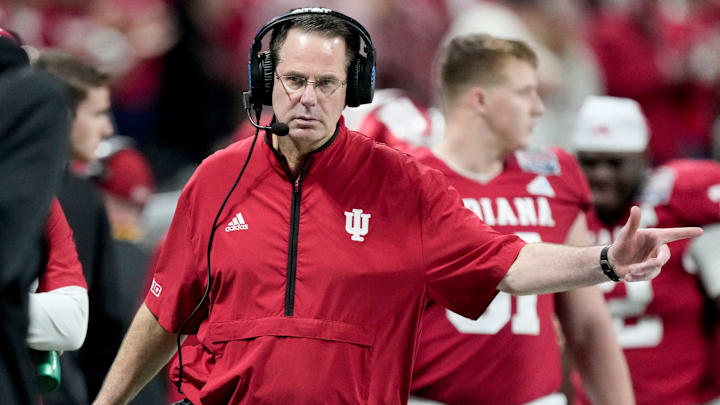
It’s genuinely bizarre how the most unlikely No. 1 team in the history of college football feels so inevitable, but that’s where we are with this Indiana team. Curt Cignetti has built a monster that destroys everything in its path. And if you’re going to help them do it, then you never stood a chance.
The thing that makes Indiana great, great enough to enter conversations with 2019 LSU as one of the greatest teams ever, is not the wave after wave of talent that those Tigers had. It’s the flawless execution of the players that Cignetti does have.
The Hoosiers never make mistakes; they’re always in the right place, and that’s created an incredible amount of trust between the coaching staff and the players. That’s never clearer than in Indiana’s defensive personnel.
All year, I’ve written about how Will Stein and Oregon are leading a renaissance of 12 personnel in college football. They dare teams to put extra big bodies on the field for fear of stopping the run because it allows the Ducks to use their athleticism to hit explosives in the passing game. Only, you don’t have to ask Bryant Haines to play base defense twice.
Haines trusts his linebackers, Aidan Fisher, Rolijah Hardy, and Isaiah Jones, that he’ll leave all three of them out there against 11 personnel groupings, let alone 12. Of course, that’s what they did on Friday night, and aside from the second drive of the game and some garbage time production, they were just fine.
However, it’s not just the linebackers that allow Indiana to play that way; it’s also the four defensive backs that are on the field behind them. D’Angelo Ponds is obviously a superstar, and he reminded everyone of that with a pick-six on the first play of the game.
Even on that play, a simple undercut, you can see the value he provides as a lockdown boundary corner, allowing the rest of the zone coverage to roll to the wide side of the field, leaving him, effectively, on an island.
Pick 6 on the first play of the game by #ChaminadeMadonna HS (FL) alum & #Indiana #Hoosiers CB D’Angelo Ponds (@DangeloPondss) vs #Oregon in the Peach Bowl pic.twitter.com/4CFQN6bXcX
— Sleeper Athletes (@SleeperAth1etes) January 10, 2026
It’s not just Ponds, though. It’s also a more unsung hero, free safety Louis Moore, because if you play that much base defense, it’s hard to have split safety looks behind it. That means, to limit explosive plays, more than just linebackers who get depth in their coverage drops, you need a free safety who can keep the lid on things, stay deeper than the deepest, and never get outleverage.
Watch Moore on this play. Stein’s design is perfect. He gets the two tight ends matched up on corners, which means Malik Benson is one-on-one with Moore, the post safety. Moore just plays it perfectly. He reads Dante Moore’s eyes and breaks on Benson’s post route before he does. There’s nothing there, so even with a four-man pressure against six offensive linemen, Dante Moore has to eat a sack. That’s rare. That’s everybody doing their 1/11. That’s Indiana football.
— Josh Yourish (@JYourish3) January 10, 2026
Second helping: Peach Bowl
4. Moore’s mistakes and another Lanning letdown
So, when you match that type of perfect execution with a pick-six, a three-and-out, and a fumble from your own six-yard line, you don’t have any chance.
There’s a conversation to be had about Moore’s NFL projection and whether or not he’ll come back to the NFL. Certainly, Fernando Mendoza cemented his place as QB1 tonight. Instead, I think the more interesting conversation is about Dan Lanning in rematches.
Despite his stellar 48-8 record across his four years as the head coach of Oregon, Lanning is now 0-3 when playing a team for the second time in a season. The first is a three-point loss to Washington in the 2023 Pac-12 Championship Game, so we can cut him some slack there. But the last two have come by a combined margin of 54 points.
In consecutive years, Oregon has found itself down 34-8 at halftime of the Rose Bowl against Ohio State and 35-7 at halftime of the Peach Bowl against Indiana. Did the Ducks just run into two teams on historically dominant postseason runs in a brand new playoff format? Or is Lanning’s team not that tough to play the second time around? I lean to the former, but the margin makes you consider the latter a possibility, and you know the Oregon fanbase won’t let him escape the rematch narrative.
Head of the table: The best individual performance earns the seat at the head of the table
5. Indiana quarterback, Fernando Mendoza (No. 1 Indiana 56 No. 5 Oregon 22)
There have been more efficient offensive performances in College Football Playoff history than the one Indiana submitted on Friday night in Atlanta. Not many, but there are some. However, there has never been a more efficient outing than Fernando Mendoza’s 177-yard, five-touchdown performance on 17-for-20 passing against the Ducks.
By Collegefootballdata.com’s PPA stat (a facsimile of EPA), Mendoza finished at 1.2 passing PPA/play in the Peach Bowl. That surpassed Joe Burrow’s 1.04 PPA/play in LSU’s 63-28 win in the 2020 Peach Bowl, in which Burrow threw for 493 yards and seven touchdowns on 29 of 39 passing. Third on the list is Stetson Bennett’s 0.96 PPA in Georgia’s 63-3 win over TCU in the 2022 National Championship game. That’s rare company for Mendoza and Indiana to keep because those are two of the biggest blowouts in CFP history.
For the second straight game, Mendoza finished with more touchdowns than incompletions. His 0.81 passing PPA/play in the Rose Bowl win over Alabama is by far the second-best of this year’s CFP, matches Will Howard’s performance against Oregon last year, and narrowly trails Justin Fields’ stellar outing in the 2021 Sugar Bowl against Clemson.
Appetizers: A little something to chew on from the week that was in college football
6. Clock management Mario (No. 10 Miami 31 No. 6 Ole Miss 27)
Mario Cristobal is the same head coach who, in 2023, ran the ball against Georgia Tech instead of kneeling the game out, which allowed the Yellow Jackets to strip the ball, recover it, and win the game with a 74-yard touchdown drive in 24 seconds. That game isn’t at all relevant to this year’s team or Thursday night’s Fiesta Bowl, but it does illustrate the depths of Mario Cristobal’s historical clock-management blunders.
Cristobal consistently wastes timeouts too early in halves, holds onto them too long, and he almost always takes his foot off the gas with a late lead. In the biggest game of his career, he did none of the above. He played his timeouts perfectly, holding onto two into the final 30 seconds, which allowed him to run the ball on first-and-goal from the eight: five-yard gain, timeout. And second-and-goal from the three: touchdown.
It was also a game in which his team, against one of the country’s fastest-paced offenses, maintained possession for over 40 minutes, but still could kick it into overdrive when both teams started to trade touchdowns late, and included two analytically correct fourth-down decisions. It was a truly impressive game-management performance from a head coach who has struggled in that department.
7. Where was Rueben? (No. 10 Miami 31 No. 6 Ole Miss 27)
The top of the 2026 NFL Draft order is set, and as the league moves into its postseason, NFL fans always look to the college football postseason with prospect intrigue. On Thursday night, that would have drawn their eye to No. 4 in white, and may have had many asking what’s all the hype about Rueben Bain Jr.? Booger McFarland was.
Well, let’s answer that question.
Bain failed to record a sack and finished the night with only one tackle, but his impact was felt. How do I know? Well, it’s not just his five QB pressures or game-high 26.8 percent pass rush win-rate, up from his season-long 24 percent, which ranked No. 4 in FBS and No. 2 in the Power 4. His impact was felt in Trinidad Chambliss’s 2.42-second time to throw and one scramble for 19 yards.
Chambliss beat Georgia with his out-of-structure heroics. In that game, he went 13-for-20 for 204 yards and a touchdown on his 20 dropbacks of over 2.5 seconds, and he wasn’t sacked once. For the year, he’s 11th in the FBS in yards per attempt on such plays. He had similar success against the Hurricanes, going 10-for-15 with a touchdown on 17 dropbacks and a score, but he was pressured on 10 of those 17 dropbacks, compared to eight of his 20 against Georgia, despite having a lower average time to throw.
So what does that say? It says that Miami was getting home. It was clear that the gameplan was to keep the undersized Chambliss in the pocket. That’s often incumbent on your edges to rush responsibly, and Bain did that. He didn’t get a sack, but he did his job. So, while Chambliss still made some magic, Miami limited the damage to just one explosive pass the entire game, forced Charlie Weis Jr. to lean on the quick game, and made Chambliss play from the pocket. There isn’t a perfect formula for a player that special, but that’s as close as you can get.
Dessert: Whether it’s a rich play design or a decadent athletic display, here’s a sweet football treat
8. Corey Hetherman’s heater (No. 10 Miami 31 No. 6 Ole Miss 27)
This season, Trinidad Chambliss was blitzed on 45.3 percent of his dropbacks, the seventh-highest rate in the country, but I can’t for the life of me tell you why. Chambliss was lethal against the blitz, averaging 7.9 yards per attempt with 14 touchdowns to zero interceptions. He has a quick release and enough experience to take advantage of the extra space in the secondary.
Well, eventually, Corey Hetherman took the bait, blitzing Chambliss on 52.4 percent of his dropbacks in the Fiesta Bowl, despite having one of the best defensive lines in the country. Chambliss hit him for 147 yards and a touchdown on 12-of-20 passing with just one sack. However, where Hetherman had success, especially early in the game, was with simulated pressures.
A simulated pressure is when a defense still brings four, but the offense can’t tell which four it’s going to be, which can force protection busts. Ole Miss’s first two possessions of the game, both three-and-outs, ended on beautiful sim pressures that had Chambliss rattled.
— Josh Yourish (@JYourish3) January 10, 2026
The first one is my favorite. The way Miami has both linebackers blitz the A-gap, which naturally forces the center to pick up one and the running back to account for the other. However, once that is declared, and Mohamed Toure gets his matchup with Kewan Lacy, Wesley Bissainthe drops back into coverage to take away the middle of the field. It’s a great way to get a one-on-one with a running back while still only bringing four.
Ole Miss eventually found answers, but Hetherman called a beauty of a game, and if his defense had held onto four interceptions that were in their hands, the scoreboard would’ve reflected that. He isn’t often mentioned with them, but he’s one of the best assistants in the country. He’s been so good from the very start of the year that it’s almost hard to remember how wretched the Miami defense was a year ago before he took over this offseason.
9. Harvey Dent (No. 1 Indiana 56 No. 5 Oregon 22)
I’m not a superhero guy, but I have seen The Dark Knight, so I’m familiar with Harvey Dent. If you’re not, he’s a recurring Batman villain who flips a coin to decide his actions, or so it seems. While it may seem as though he’s leaving it up to fate, Dent is always in control, manipulating the outcome of the coin flip to turn a 50/50 proposition into 100/0.
That’s what it’s like throwing to Indiana’s receivers. Every 50/50 ball is seemingly a 100/0 proposition, at least it was for Fernando Mendoza, Elijah Sarratt, and Charlie Becker on Friday night. It didn’t matter the coverage Indiana had on the 6-foot-3, 213-pound Sarratt or the 6-foot-4, 209-pound Becker; they were coming down with the football.
Mendoza to Sarratt has become automatic pic.twitter.com/jlFEcWurqe
— Billy M (@BillyM_91) January 10, 2026
The Mendoza-to-Sarratt back shoulder throw is going to be one of the lasting images of this season, a play that carries an unfathomable sense of inevitability, but Becker has somehow been better, coming into this matchup with an over 80 percent contest catch rate this year.
charlie becker touchdown; fernando mendoza; oregon vs indiana pic.twitter.com/uQv4qj66Pc
— ◇ (@F0RGIAT0) January 10, 2026
There just isn’t any way to defend this throw, and the fact that his receivers are always going to come down with it is a big reason that Mendoza has had the season he’s had. The amount of confidence that has to give you as a quarterback is hard to quantify.
Elijah Sarratt makes ridiculously tough contested catches look …. easy.#CFBPlayoff
— Matt Hanifan (@mph_824_) January 10, 2026
pic.twitter.com/AayubmxE3N
A new recipe: With their season over, these eliminated teams need to cook up a new recipe this offseason
10. Ole Miss
A day after the Rebels’ Fiesta Bowl loss, they got dealt another serious blow as Trinidad Chambliss was denied his waiver for an additional year of eligibility, and assuming that decision isn’t overturned, he’ll be heading to the NFL. With backup quarterback Austin Simmons leaving for Missouri, Ole Miss has been predicted to land Auburn transfer Deuce Knight out of the portal.
Knight, a former five-star, has just one career start under his belt, waxing Mercer late in the year. Though it was against FCS competition, Knight showed why he’s a tantalizing talent, rushing for 162 yards and four touchdowns on nine carries. With Kewan Lacy set to return and not transfer to LSU with Kiffin, the Rebels should have one of the best rushing attacks in the SEC. Pair that with a defense that has Suntarine Perkins, Will Echoles, Princewill Umanmielen, Antonio Kite, and plenty of others back, and Ole Miss will be a contender.
The question is how hard Golding will go in the portal. Kiffin was the self-proclaimed portal king. Golding has a reputation as a better high school recruiter. If he makes that shift, there could be a few lean years coming as Kiffin transfers age out and Golding recruits develop into major contributors. Once you step on the portal treadmill, it’s hard to get off.
11. Oregon
It’s too simple for all of these look-aheads to distill down only to quarterback questions, but that’s by far the biggest question mark in Eugene. Dan Lanning’s 2024 and 2025 recruiting classes were two of the best in program history, both ranking inside the top five nationally. Both have already begun to bear fruit.
In 2025, Oregon had the second-most touchdowns scored by true freshmen in the entire country. Dakorien Moore is a stud at wide receiver, Brandon Finney was the defensive MVP of the Orange Bowl, and the young stable of running backs is as good as any in the country. With so much young talent, this wasn’t supposed to be the year that Oregon competed for the title, but the Ducks got to the CFP semifinals a year ahead of schedule. Now, they need to figure out who will be quarterbacking that talented roster in 2026.
Moore could absolutely return. He’s just 20 years old with only 20 starts under his belt. If he does, it takes the Ducks out of the transfer portal market. If he leaves for the NFL, though, Lanning will need to make up serious ground for a top portal QB like Sam Leavitt or Dylan Raiola, whom ESPN’s Pete Thamel connected to the program during the pregame show. Oregon already spends big, but it should spare no expense to get the right guy at QB, because with that collection of young talent, the Ducks could be the Big Ten’s next superteam to steamroll its way through the CFP after getting flattened two years straight.
Order up!: Now we know what’s on the menu for the national championship, so what will be the keys to deciding it?
12. Big-arm Beck? (No. 1 Indiana vs No. 10 Miami)
The national championship game isn’t until January 19, so we have plenty of time to preview and break it down before then. But there is one question that I don’t expect to escape my analysis, and that is: can Carson Beck handle pressure, and beat Indiana over the top?
While Beck has played much better of late, and I raved about his performance in the Fiesta Bowl, he hasn’t necessarily improved his play under pressure, just changed his weakness. For much of Beck’s career, his issue, especially in a muddy pocket, has been interceptions. That was the case through the first eight games of the year with three interceptions on pressured dropbacks, 6.4 yards per attempt, and a 3.33-second time to throw with an 8.1 percent pressure-to-sack rate.
However, through the last seven games, Beck has become less aggressive as a thrower when pressured, shrinking his interception total to 0 under pressure, but increasing his time to throw to 3.55 and his pressure-to-sack rate to 26.1 percent. Instead of a high-turnover player, he’s a high sack player. That’s been a better play-style for Miami, with its ball-control run game and stout defense, to live with, but you can’t start playing from behind the chains against Indiana, especially not if you expect to run your way out of it.
Indiana fits the run as well as any team in the country, and with Bryant Haines’s pressure packages, they’re going to get home on Beck. To win, he’ll have to do what Julian Sayin, Ty Simpson, and Dante Moore couldn’t: beat them over the top.
It doesn’t help, though, that Beck’s arm hasn’t looked the same coming off his elbow surgery, and against Ole Miss, he went 1-for-7 on throws over 20 yards downfield with some bad misses. Through Miami’s three CFP games, granted one was in a wind storm in College Station, he’s 1-for-11 on those throws.
 Add us as a preferred source on Google