

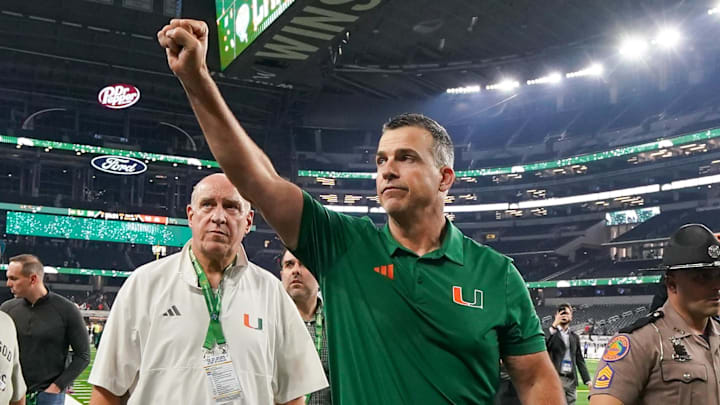
If you want to know how much has changed in college football over the last few years, we’re heading into a College Football Playoff semifinal featuring Oregon, Indiana, Ole Miss, and Miami. If you want to know how much is the same, all four of those teams are coached by former Nick Saban assistants.
The impact of the NIL and transfer portal era cuts deep into the heart of the sport, but the roots of the Saban coaching tree run deeper. No matter the era, great coaches will find a way to win, and that’s exactly what Mario Cristobal, Dan Lanning, Curt Cignetti, and yes, even Pete Golding (with a lot of help from Charlie Weis Jr.) did in the CFP quarterfinals as the calendar turned to 2026.
Now, we have to ask ourselves what would be most impressive: Taking over the losingest program in FBS history and winning a national championship two years later, finally bringing the U back after it had been declared so, so many times before, or running to a national title in your first four games as a head coach?
But before we look ahead to answering that question next week. We have to look back at the CFP quarterfinals and figure out why Ohio State, Texas Tech, Alabama, and Georgia had to leave our college football dinner party.
First Course: Cotton Bowl
1. The U is back, and so are Ryan Day’s haters (No. 10 Miami 24 No. 2 Ohio State 14)
For the first time since the 2023 Cotton Bowl against Missouri, Ryan Day took over play-calling for Ohio State ahead of the 2025 Cotton Bowl semifinal on New Year’s Eve, with offensive coordinator Brian Hartline splitting time as the newly-hired head coach at USF. It didn’t go well.
It’s not that Ryan Day is a bad play-caller. Not at all. But Ryan Day had a flawed gameplan and a roster that had more flaws than we knew throughout the regular season. After being sacked six times all season, Julian Sayin has been sacked 11 times across the last two games as the Buckeyes managed 10 points against Indiana and 14 points against Miami.
The flaw in the roster is obvious in hindsight. Ohio State’s offensive line just wasn’t good enough. Reuben Bain finished with a sack, six pressures, and a 24.3 percent pass rush win rate. Akheem Mesidor recorded two sacks, five pressures, and had a 17.9 percent win rate. And Miami added seven tackles for loss on top of its five sacks.
Corey Heatherman’s defense did a great job rolling coverage on the back end to get Sayin to pat the ball, and their size in the secondary allowed them to tackle really well. But this game was pure trench play dominance, which is kind of the entire idea of hiring Mario Cristobal as your head coach.
The flaw in Day’s gameplan was harder to see until the Buckeyes finally just ran out of time. All season, Ohio State played at a slow pace and dominated low-possession games. That was essentially the gameplan last season as Day pioneered a load management style that helped him conquer a 16-game schedule. Last year, though, when the playoff hit, he flipped a switch and sent his offense into overdrive with aggressiveness and tempo. This year, that switch never flipped.
Ohio State finished the game with just 59 total plays. So, despite averaging 5.6 yards per play and posting a 53 percent success rate, the highest Miami has allowed all season, the Buckeyes were doomed by Sayin’s early pick-six, and a missed field goal at the end of the first half because they only got four possessions after the intermission to try and erase a 14-0 halftime deficit. You just have to be perfect, and Sayin almost was, but this isn’t horseshoes or hand grenades.
In a low-possession game, it’s not just turnovers and red zone trips that get amplified; it’s also third down. It’s a shame that I’m just now getting to Carson Beck in the seventh paragraph of this breakdown because he was truly fantastic. Beck attempted just two passes over 15 yards downfield and didn’t complete a single one, but he was downright masterful on short and intermediate throws, especially on the money downs.
Ohio State’s defensive gameplan was designed to get Miami into third and obvious passing situations, and it worked. The Canes forced Beck to pass 10 times on third down. He was nails. The sixth-year senior completed seven of his 10 third-down throws for 66 yards. His late-down passing success rate of 64 percent was second only to UCLA (weird, right) against the Ohio State defense this year. Only Miami, UCLA, and Indiana produced a better than 50 percent success rate in those instances and six of Ohio State’s opponents failed to crack 20 percent.
A major component of Beck’s success was Dawson’s ability to create leverage with his formations to help spring receivers, but Beck still had to make the throws, and his accuracy and pocket management were those of a player with 40 collegiate starts already under his belt.
With Ole Miss, not Georgia, waiting in the Fiesta Bowl, Beck has the U all the way back and one win away from a national championship.
Second Course: Orange Bowl
2. Dante Moore is different (No. 5 Oregon 23 No. 4 Texas Tech 0)
You can quibble over that statement regarding his NFL translation or even his big-game performances this season, but Dante Moore is undeniably different than almost any quarterback that Texas Tech’s defense has faced all season. The only one in the same realm as a passer is Sam Leavitt, and he and Arizona State are responsible for the Red Raiders' only other loss of the season. Moore and Leavitt were the only QBs to average more than six yards per dropback against Texas Tech this season
That matters because while Texas Tech’s defense is loaded with elite talent, it’s not a particularly complicated unit under defensive coordinator Shiel Wood. Wood’s system leans on the talent of his loaded defensive line and sure tackling linebackers, living in shell zone coverages, keeping everything in front and forcing the opposing QB to dink and dunk their way down the field.
It’s a strategy that makes a ton of sense. Forcing lengthy drives dares offenses to be perfect, and more importantly, it gives David Bailey, Romello Height, A.J. Holmes, and Lee Hunter more opportunities to make a drive-killing play, either a sack or a tackle for loss. That’s what Bailey and Hunter did to end Oregon’s first two possessions of the game, holding the Ducks to just three points despite moving the ball well because of a sack and a tackle for loss in the red zone.
Most quarterbacks will make enough mistakes against that kind of pass rush to give the game away. Dante Moore isn’t most quarterbacks. The 20-year-old redshirt sophomore finished 26 for 33 for 234 yards and an interception, which came on fourth down. He completed 20 of his 21 throws under 10 yards downfield for 126 yards, and averaged eight yards per attempt on throws from 0-9 yards from the line of scrimmage with a 2.09-second time to throw. That’s the type of precision you need to beat an elite defense, and he made it look easy.
Third Course: Rose Bowl
3. Indiana might just be that team (No. 1 Indiana 38 No. 9 Alabama 3)
We’ve been searching for college football’s superpower all season, but maybe Indiana really is just that team. Maybe the Hoosiers are just going to run roughshod through the CFP and become the first team ever to finish as a 16-0 national champion. They certainly looked the part in Pasadena.
Teams with a first-round bye in the 12-team CFP era are now 1-7 after Thursday. The 1 is Curt Cignetti’s Hoosiers. Now, that stat is a bit misleading because last season Boise State was the No. 3 seed and Arizona State was No. 4, and both were major underdogs in the quarterfinals. Still, this year, Ohio State, Texas Tech, and Georgia all suffered a similar fate to last year’s Oregon Ducks and Georgia Bulldogs. Yet Indiana looked plenty rested and without a speck of rust.
The Hoosiers dismantled Alabama, handing the Tide their largest postseason defeat in program history while the Heisman Trophy winner attempted just 16 passes, throwing more touchdowns (3) than incompletions (2). Mendoza was precise, but the physicality is what stood out, and it’s why veteran centre Pat Coogan, not Mendoza, was named the game’s offensive MVP.
The Hoosiers ultimately finished with a 43 percent rushing success rate, but that’s a misleading metric. Indiana rushed for 215 yards and 2 touchdowns on 50 carries with 11 missed tackles forced and 188 yards after contact. That’s imposing your will. That’s what Alabama used to do to the rest of college football. It’s certainly not something anyone ever would have expected Indiana to do to Alabama, even a year ago, after Cignetti’s first CFP trip.
Alabama DC Kane Wommack wasn’t stuck between a rock and a hard place; it was more like a steamroller and a rocket launcher. He prefers to play shell zone coverage to limit explosives and hopes he can win enough with a four-man rush. When he played with light boxes and deep safeties, Indiana ran the ball at will. When he blitzed, and on Thursday, he pulled out his highest blitz rate of the season, bringing extra rushers on 15 of Mendoza’s 22 dropbacks, it was bombs away.
Mendoza produced an absurd 26 percent explosive pass rate against Alabama. When blitzed, though he was sacked three times, he went 9-for-10 for 167 yards and three touchdowns. His 16.7 yards per attempt is the most by a QB with at least 15 blitzed dropbacks in a single game since Charlotte’s Conner Harrell averaged 16.8 ypa in Week 3, and the most by a Power 4 QB since SMU’s Kevin Jennings averaged 20.0 ypa in Week 8 of 2024 against Stanford.
Blitzing and playing more man coverage is the right strategy against an offense that relies heavily on RPOs. It just didn’t matter. Mendoza is too accurate, especially under pressure, and Indiana’s receivers are too big and physical to shut down in one-on-ones.
There really isn’t an answer for the Indiana offense. Ohio State was the closest to finding it, and the Buckeyes just got sent home. Now we get an Oregon/Indiana rematch of one of the best games of the regular season, but it’s hard to come up with a reason why Indiana won’t roll in the Peach Bowl.
Fourth Course: Sugar Bowl
4. Pete Golding’s Midas Touch (No. 6 Ole Miss 39 No. 3 Georgia 34)
Pete Golding now has two College Football Playoff wins as a head coach. Lane Kiffin still has none. It sucks that we have to start there with this ridiculously fun football game, but we have to start there with this ridiculously fun football game. Lane Kiffin looked at his 11-1 football team and decided he couldn’t win a national championship at Ole Miss so he decided to forgo the best chance to win a national championship he’s ever had for a theoretical chance to win a national championship at LSU, and now he’s getting what he deserves (and a bonus in his LSU contract for Ole Miss CFP wins that he certainly doesn’t).
The only good news for Lane is that Charlie Weis Jr. is coming with him to Baton Rouge because, brother, does he have the goods or what? Weis’s offense and Trinidad Chambliss were good enough to overcome a Kewan Lacy fumble returned for a touchdown, a failed two-point conversion, a failed fourth down near midfield in the third quarter, and Kirby Smart’s successful fake punt late in the third quarter.
In the past, Smart has had some struggles slowing down the type of deep option-route passing attack with wide formational splits that Kiffin and now Weis run at Ole Miss. So, this time, rather than play off coverage and surrender the underneath stuff while keeping a lid on the deep passing game, Smart had his corners get up and challenge wide receivers at the line, and blitzed Chambliss on 54 percent of his dropbacks.
It seemed like a logical adjustment after the Week 8 meeting when Chambliss averaged 12.5 yards per attempt on throws under 10 yards downfield and the Rebels racked up 199 yards after the catch. Dare Chambliss and his receivers to make big plays downfield against a long and physical secondary. The plan backfired.
Not only did Chambliss torch the blitz for 171 yards and a touchdown, Georgia barely ever got home with it. He was not sacked and was pressured on just nine of his 46 dropbacks. And when he was, he turned into a magician.
TRINIDAD CHAMBLISS. OH MY GOODNESS.
— MLFootball (@MLFootball) January 2, 2026
WE ARE WITNESSING GREATNESS.
THIS MAY BE THE GREATEST BACK-TO-BACK PLAYS WE HAVE EVER SEEN EVER.
pic.twitter.com/j2Yz0S9pkm
Then, there were the downfield throws. With Georgia blitzing and playing press, the one-on-ones were there, and Chambliss didn’t miss them. He completed four of his seven throws over 20 yards downfield for 145 yards en route to setting the Sugar Bowl record with 362 yards and two touchdowns.
Weis wasn’t afraid to meet Smart’s challenge head-on, and like every great play-caller, his quarterback made him right.
trinidad chambliss to harrison wallace; ole miss vs georgia pic.twitter.com/LcPUwESpEX
— ◇ (@F0RGIAT0) January 2, 2026
Head of the table: The best individual performance earns the seat at the head of the table
5. Ole Miss QB, Trinidad Chambliss (No. 6 Ole Miss 39 No. 3 Georgia 34)
It’s difficult to imagine Trinidad Chambliss playing better than he did in the Sugar Bowl on Thursday night. The last time the DII transfer drew a matchup with Georgia, in his first FBS road game, he went ice cold in the fourth quarter, completing one of his 10 attempts for one yard as Georgia scored 17 unanswered points to overcome a 35-26 deficit to win 43-35.
This time around, Chambliss was ice cold. He began the quarter with six straight completions, part of a stretch of 13 in a row, for 87 yards and a touchdown. His elusiveness was otherworldly, his accuracy was dialed, and after surrendering a 10-point lead to let the Bulldogs tie it at 34, he dropped one in a bucket to De’Zhaun Stribling for 40 yards to put Lucas Carneiro in field goal range for the game-winner.
Despite a four percent explosive pass rate, Chambliss averaged 0.22 EPA/play, 10.18 total EPA, and an absurd +37 percent win probability added. Ole Miss finished with 74 offensive plays, and through 51 of them, the Rebels’ total offensive EPA was -5.82.

From that play on, Ole Miss generated a total EPA of 15. That’s 0.65 EPA/play. For a full game, that would be the most efficient offensive performance against a Georgia defense since Kirby Smart took over. That’s after Ole Miss’s regular season performance was the best by EPA/play against Georgia in CollegeFootballData’s database, which stretches back to 2003.
Appetizers: A little something to chew on from the week that was in college football
6. Bryant Haines plays with fire, and never gets burned (No. 1 Indiana 38 No. 9 Alabama 3)
Bryant Haines is my favorite defensive coordinator in college football right now, and it’s not particularly close. His pressure packages are so precisely designed crack the specific protection look of his opponent, and his coverage disguises have given even the most veteran quarterbacks fits. Yet, what I love most about Haines is his sheer audacity.
I’ve written before about how Haines matches opponents’ 12 personnel grouping with a base 4-3 defense, leading pristine run fits, and yet he manages not to get burned in the deep passing game with so many big bodies in coverage. Well, on Thursday against Ryan Grubb, Kalen DeBoer, a veteran QB in Ty Simpson, who loves to attack the middle of the field, and one of the country’s most talented wide receiver corps, he played significant snaps matching 11 personnel with three linebackers.
That’s not just playing with a few matches; that’s doing rhythmic gymnastics covered in gasoline with a flame thrower. And for no reason whatsoever against an offense that ranks 131st in rushing success rate. Alabama managed a six percent explosive play rate, and Ty Simpson didn’t complete a single pass over 15 yards downfield.
Haines paired his big-bodied personnel with two deep safety looks, which should leave vast expanses open in the middle of the field, especially off play-action. Again, Simpson went 1-for-1 for 13 yards on throws over 10 yards downfield and between the numbers and threw for 33 yards off play-action. Austin Mack, who replaced Simpson inthe third quarter, didn’t fare much better.
It’s a credit to the coverage ability of Indiana’s linebacker group and the depth that they get in their coverage drops, and it’s a credit to Haines for daring to be different in a sport of 4-2-5 and 3-3-5 defenses and dominating because of it.
Dessert: Whether it’s a rich play design or a decadent athletic display, here’s a sweet football treat
7. False pull. Real pretty. (No. 10 Miami 24 No. 2 Ohio State 14)
I’ll never not love a false-pull tunnel screen. There’s a big difference between a run fake and run-action, and that difference is one of the reasons that Miami is going to the CFP semifinal.
What a call by Shannon Dawson with the game on the line!
— Coach Dan Casey (@CoachDanCasey) January 1, 2026
False Pull + Tunnel Screen pic.twitter.com/ExxRgvOwIR
On this got-to-have-it third-and-4 that preceded CharMar Brown’s game-clinching touchdown in the fourth quarter, Carson Beck doesn’t even need a ball-fake before hitting CJ Daniels on the perimeter. Still, offensive coordinator Shannon Dawson buys Daniels space by pulling right guard Anez Cooper to the left side. That action causes Ohio State’s linebackers, Payton Pierce and Sonny Styles, to trigger downhill, and by the time they realize it’s not a run, it’s too late.
Oh, and the athleticism of Francis Mauigoa to get a piece of Caden Curry is incredible. Dawson builds so much of Miami’s run and screen game around Mauigoa. He’s a real offensive weapon that very few teams have at tackle.
8. The young Ducks (No. 5 Oregon 24 No. 4 Texas Tech 0)
Oregon came into the Orange Bowl with the second-most touchdowns by true freshmen in the country this season, and added two more with Dierre Hill Jr. scores. However, it was true freshman cornerback Brandon Finney Jr. who was the game’s biggest star. Finney finished with two interceptions and a fumble recovery, one of the greatest individual defensive performances in CFP history.
brandon finney interception; oregon vs texas tech pic.twitter.com/xTJlzoV7JY
— ◇ (@F0RGIAT0) January 1, 2026
The most impressive part of his game, to me, however, was his tackling. Finney is a 6-foot-2, 203-pound corner, so he’s not exactly undersized for the position, but he plays even bigger than his impressive measureables. Finney is constantly getting his hands dirty in the run game, fitting the extra gaps that Texas Tech was constantly attempting to create on the perimeter and racking up six tackles in the game.
Cornerback run fits are the type of thing that separates championship teams this time of year, and getting that level of disciplined play from a true freshman is a huge testament to Lanning and his staff. Much like how Mario Cristobal has his superstar freshman wide receiver delivering huge blocks in crucial moments.
Young WR’s, take a look at Malachi Toney.
— Jake Franklin Football (@JakeFranklinFB) January 1, 2026
He’s not afraid to block violently inside of the box in the run game. This will separate you from most other WR’s! ✍🏼 pic.twitter.com/Mt04qy6gLV
It’d be fun to see those two young bucks mix it up in Miami in a couple of weeks if that’s how the semifinals play out.
A new recipe: With their season over, these eliminated teams need to cook up a new recipe this offseason
9. Ohio State
Dare I say run it back? As much as you can, of course. Ohio State could be set to lose as many as five players to the first round of the 2026 NFL Draft, and after having 14 players drafted in 2025, that talent drain is impossible to ignore and difficult to replenish. Still, Day has Sayin and Smith coming back with a young group of running backs, and class after class of four and five-star talent.
The most interesting part of Ohio State’s offseason will be who Day hires to replace Hartline, not just as his play-caller, but as his ace recruiter. Day needed Chip Kelly to bring his own offensive identity to the program to finally get over the hump and win it all. Could another big-name outside hire be coming down the pike after the offense fell flat in its two biggest games of the year? I hope so.
10. Texas Tech
Texas Tech has to complete reload its roster this offseason, and that starts on Friday when the transfer portal opens. Luckily for Joey McGuire, with oil baron Cody Campbell’s backing, they’ll have as much money to spend as any program in the country. David Bailey, Romello Height, Lee Hunter, and Skyler Gill-Howard have all exhausted their eligibility, so the reload needs to start on the defensive line.
I have little doubt that McGuire and Campbell will conspire to construct the most talented roster in the Big 12. There really isn’t another team in the league that can match their offseason spending sprees. However, for Texas Tech to be more than just a Big 12 merchant, the Red Raiders need a quarterback who can match the Dante Moores and Sam Leavitts of the world blow for blow. In this transfer portal market, aside from Leavitt himself, that player is Cincinnati transfer Brendan Sorsby.
Sorsby is a big athlete who refuses to take negative plays and can push the ball downfield with accuracy and touch. He’d be a great fit in Mack Leftwich’s multiple spread attack, and while spending the five million or so it’ll take to get Sorsby for his final season of eligibility is a bit steep for teams operating within the $21 million revenue-sharing cap, it’s a drop in the bucket for Campbell.
Saturday Blitz Transfer Portal QB rankings 2026
11. Alabama
Kalen DeBoer said postgame that, “there is a fine line between what we had out there today and being at the very top.” To me, and everyone with eyes, that’s a charitable assessment of his team’s performance against the undefeated Big Ten Champs.
In actuality, Alabama, despite winning a CFP game and making the SEC Championship this year, is a long way off from winning its 19th national title. There are serious questions about the quarterback position in Tuscaloosa and whether or not Ty Simpson will return for his redshirt senior season. Then, there are the dominoes that will fall based on Simpson’s decision with Austin Mack and 2025 five-star Keelon Russell.
However, the more important question to answer long-term for Kalen DeBoer is whether or not to continue his partnership with longtime offensive coordinator Ryan Grubb. Grubb does excellent work in the passing game, leveraging formational alignment and motion to create space for his receivers as well as anyone. But he didn’t last in the NFL beyond one season because he couldn’t run the ball. Then, he turned around and produced the 131st rushing success rate in the country in his reunion with DeBoer.
Alabama’s offensive line was not good this year. Neither was Seattle’s in 2024. Yet, Grubb didn’t do much to help the cause. He won’t make a change this offseason, and probably shouldn’t, but Grubb needs to figure out how to run the football, or the Alabama offense will always have a hard ceiling.
12. Georgia
Needless to say, Georgia is in good hands. Kirby Smart is still a dominant recruiter in one of the nation’s great talent hotbeds; the Dawgs will be alright. The Dawgs aren’t perfect, though. There’s a reason that the team was stuck in so many dogfights all year, and it’s two of the three most valuable (translation: expensive) positions in the sport.
Zachariah Branch, one of four notable wide receiver transfers on a team overwhelmingly constructed through high school recruiting, accounted for 25 percent of the team’s receiving yards and 27 percent of the team’s receptions. The team’s next three receivers combined for four fewer grabs than Branch did this season. That type of siloed passing attack, even with a game-breaking talent like Branch, isn’t particularly sustainable. And Branch could be heading to the NFL.
On the other side of the ball. Georgia had just one player record more than 20 quarterback pressures this season, and it was linebacker Raylen Wilson. Wilson and Chris Cole were the unit’s leading pass-rushers by pressures, and Christen Miller, the team’s leader by pass-rush win-rate at 11.7 percent (among players with at least 100 pass rush snaps), ranks 238th in the country.
Gunner Stockton can win a championship. Aside from Chambliss, he was the best player on the field on Thursday night in New Orleans. But unless Georgia adds or develops a few more pass rushers and pass catchers, the Dawgs will fall short in the postseason once again.
 Add us as a preferred source on Google