

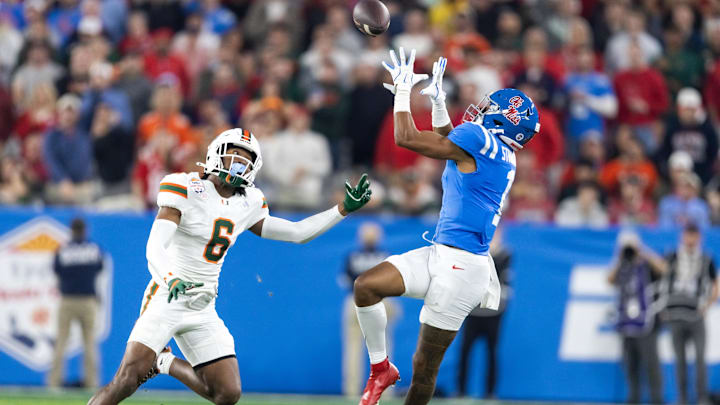
One of the most controversial rules in all of college football is how targeting penalties and the are handled. A player who gets called for targeting in the 1st half of a game is ejected and misses the 2nd half of a game while a player ejected in the 2nd half misses the entire 1st half of the following game while the team is given a 15-yard penalty.
This rule became the focus when Miami defensive back Xavier Lucas was called for targeting in the 2nd half of the Fiesta Bowl against Ole Miss which meant he missed the 1st half of the National Championship Game. The call itself was controversial, and the fact that it affected the National Championship made it even worse.
It’s not being talked about enough how ridiculous it is that Xavier Lucas has to sit out the first half of the title game because he tried to tackle the lower body of a receiver being led into him by his QB as the WR twisted his body down into his helmet.pic.twitter.com/oT3F5l3lnr
— David Furones (@DavidFurones_) January 16, 2026
Changes could be on the horizion for targeting
On Wednesday, Yahoo Sports' Ross Dellenger reported that the NCAA Football Rules committee was poised to recommend eliminating the carry-over suspension that comes with a first offense target violation.
NCAA FB Rules Committee is poised to recommend eliminating the carry-over suspension that comes with a first offense targeting violation, sources tell @YahooSports.
— Ross Dellenger (@RossDellenger) February 26, 2026
First offenders flagged in the second half will not be required to sit the first half of the following game.
The current rules have no changing rules based on how many offenses a player has racked up except for any player who receives their 3rd targeting penalty in a season is automatically given a one-game suspension.
Changing the rules to give first time offenders the benefit of the doubt would be a great step in the right direction. A player ejected in the first half will still miss the rest of the game, but it makes sense to avoid having a play effect multiple games.
The rules change would be a great first step, but there's still plenty of room for the NCAA to continue making the rule better. Many have suggested a targeting call with a targeting with intent differentiator that would allow the officials to make the calls by the exact rules, but in a case where it's clear the player didn't intend to target they aren't ejected which could be a great next step.
 Add us as a preferred source on Google