

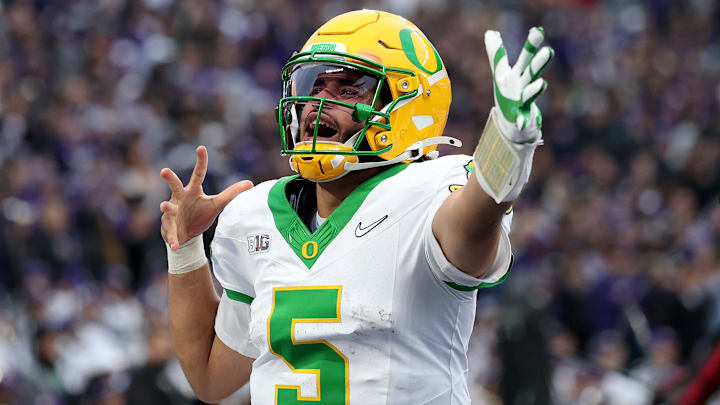
We’re in Year 2 of the 12-team College Football Playoff, but no matter the format to decide a champion in college football, it often comes down to one position: the quarterback.
Especially now in the era of the transfer portal, NIL, and revenue-sharing, which have helped to spread the wealth of talent across the country and level off the top of the sport, quarterbacks can be the ultimate differentiators.
Indiana, for example, doesn’t have years of top 10 recruits classes loaded with five-stars stacked on top of each other, but with two straight strong showings in the transfer portal, including nabbing the eventual Heisman Trophy winning quarterback from Cal last offseason, Curt Cignetti’s Hoosiers enter the postseason as the undefeated Big Ten Champions and the No. 1 seed in the CFP field.
Quarterbacks, in many ways, determined the 12-team field, so it stands to reason that ranking them could give some insight into how the bracket will play out. And of course, we have to start with the man who just hoisted the Heisman at No. 1.
I think that you could make an argument that Julian Sayin had a cleaner season, and there’s a statistical case to be made that the Ohio State redshirt freshman was the most efficient passer in the country, but the Big Ten Championship Game proved why Mendoza deserved the nod for the Heisman and the No. 1 spot in these rankings.
Two elite defenses, in their own unique ways, dared the opposing quarterbacks to beat them, and Mendoza burned the Buckeyes more than Sayin did the Hoosiers. Mendoza may not have elite NFL arm strength, but he can make every throw on the field. He has great ball placement on RPOs and play-action over the middle of the field to maximize yards after the catch, he can push it downfield outside the numbers, and crucially, he can make plays under pressure.
Mendoza isn’t an elite runner, but he has more than enough mobility to make plays outside of structure or burn a defense if they play man coverage and turn their back to him. He has all the tools to lift a team like Indiana to a title, and with big-time fourth-quarter drives against Oregon, Penn State, and Ohio State, he’s proven that he’s impervious to the pressure of the moment.
Yes, he’s throwing to a wide receiver duo that would probably rank in the top 10 in the NFL right now. Regardless, Sayin has been excellent. He’s pinpoint accurate with an FBS-best adjusted completion percentage of 84.3 percent, even when he’s aggressively attacking downfield. On throws over 20 air-yards, Sayin ranks first in the FBS with a 65.1 percent completion rate and 12 touchdowns to zero interceptions. Certainly, his wide receivers who turn 50/50 balls into an 80/20 proposition help, but Sayin’s 25.4 yards per attempt on such throws is nearly five years better than Kent State’s Dru DeShields, who is second best in the country.
While his accuracy is his superpower, Sayin has also been excellent at avoiding negative plays. His stellar 12.6 percent pressure-to-sack rate allows Ohio State’s offense to stay on schedule and allows him to throw the ball from neutral script rather than backing himself into obvious passing downs. Ryan Day has leaned into 12 personnel (1 running back, 2 tight ends) usage to exacerbate that run-pass conflict, but even without it, Sayin thrives. Ohio State is tied for fifth in success rate on passing downs and is third best among teams in the CFP field.
Poise is the first word that comes to mind with Dante Moore. His ability to navigate the pocket while maintaining clean footwork and keeping his eyes downfield is NFL-caliber, and it’s why he’ll likely be the second quarterback taken in the 2026 NFL Draft (behind Mendoza).
That ability to navigate the pocket is why, despite not being an overly athletic player, he ranks No. 8 in the FBS in yards per attempt on dropbacks over 2.5 seconds. His adjusted completion percentage on such dropbacks is second only to Sayin, and his big-time throw rate (as graded by PFF) is ninth best.
Like Ohio State, Oregon has relied on 12 personnel to dare opponents to load the box to stop the run, so they can hit explosives over the top. Unlike Ohio State, Oregon doesn’t have an embarrassment of riches at wide receiver. Moore has been without Evan Stewart all year and closed the season without Dakorien Moore and missing Gary Bryant Jr. for stretches. With a rotating cast of pass catchers, his ability to buy time is even more important because they need an extra beat or two to come open.
There was a point this season that Ty Simpson may have been No. 1 for me on this list. When you consider how poorly Alabama is running the ball (131st in rushing success rate) and how he’s asked to carry the offense for Kalen DeBoer and Ryan Grubb, you can still argue that he’s as valuable as any player not named Diego Pavia. Now, however, he’s No. 4 and the final player in what I consider to be the top tier. The reason for that drop is turnovers.
Simpson can make every throw. His anticipation and touch allow him to punish defenses over the middle of the field, and his elite processing allows him to get the ball out of his hands quickly. However, because he trusts his arm and his accuracy, he’s willing to attempt some high-risk throws. Early in the year, those didn’t bite him. Lately, especially in the regular-season loss to Oklahoma, they have.
Compound his fearless nature with the realization that he has to carry the entire offense, and you have a quarterback who will hold onto the ball for an extra beat if he doesn’t have an open receiver early. That’s led to a fumbling problem and a climbing sack rate.
First, it’s important to admit that Trinidad Chambliss plays in an incredibly quarterback-friendly offense. Lane Kiffin, now the head coach at LSU, who won’t be on the sidelines in the CFP, and Charlie Weis Jr., who will be calling the plays for Ole Miss throughout the CFP, built a system that can get the best out of any quarterback. However, Chambliss isn’t just any quarterback.
The former DII transfer doesn’t have an elite arm, and that’s reflected in his 47.3 percent completion percentage on throws outside the numbers over 10 yards downfield. However, he’s accurate and decisive, which allows him to threaten the middle of the field and do so without putting the ball in harm’s way. He’s poised under pressure, hunts big plays off play-action, and is hyper-efficient, averaging 6.33 yards per dropback, fourth in the country and the best in the CFP field.
Gunner Stockton has a real weakness against zone coverage. He much prefers to play against a defense that will man him up because then he can pick his matchups, and he’s quite an accurate thrower in those scenarios. Not to mention, he has a wide receiver corps made up of quick separators and contested catch winners who thrive in one-on-ones.
Stockton’s efficiency drops against zone defenses, and you see his scramble rate greatly increase. Georgia Tech had a very effective gameplan for him in the final game of the regular season, often dropping seven or eight into coverage, keeping eyes on him as a scrambler, and making him read out concepts.
However, it’s hard to live that way forever, especially as Georgia’s run game rounds into form. And, for that significant weakness, Stockton is still an upgrade over Carson Beck because he’s tough and willing to stand in the pocket, which makes him great under pressure. On pressured dropbacks this season, Stockton is first in adjusted completion percentage. When blitzed, which is typically accompanied by man coverage, Stockton is even better, with an 86 percent adjusted completion percentage (2nd), 8.0 yards per attempt, and 17 touchdowns to 1 interception with a 2.49 second average time to throw.
Carson Beck is the same quarterback he was at Georgia, even after his offseason elbow surgery. When he’s kept clean and sees a clear picture on the backend, he’s decisive, fairly accurate, and sets up his receivers to run after the catch. However, when the pocket is muddy, the secondary can disguise its coverages, and he’s forced to hold onto the ball, he becomes turnover-prone.
The only difference between this resurgent season at Miami and his final year at Georgia is that he plays a lot more of defenses in the latter category than the former. Unfortunately for him, Texas A&M is No. 13 in the country by defensive EPA/dropback.
Carson Beck | vs. top 60 pass D (EPA/DB) | vs. pass D outside top 60 |
|---|---|---|
Comp% | 73.1% | 76.1% |
YPA | 8.5 | 8.9 |
TD/INT | 10/9 | 18/2 |
Win/Loss | 3-2 | 8-0 |
ADOT | 8.8 | 6.2 |
Time to throw | 2.47 | 2.26 |
If you want to see the floor and the ceiling of Marcel Reed as a college quarterback, watch the South Carolina game. In the first half, he played about as poorly as you could imagine, indecisive and inaccurate, constantly turning the ball over as he dug the Aggies a 30-3 deficit. Then, in the second half, he was throwing darts all over the field, using his athleticism to evade the South Carolina pass rush and gobble up yardage as a scrambler with his long strides and slender frame.
Reed can be a linebacker’s worst nightmare. Not just because he’s tough to tackle in space, but because if you get sucked towards the line of scrimmage to play the run, he’ll wiz a throw past your ear hole to KC Concepcion or Mario Craver, two of the most dynamic catch-and-run players in the country. That’s why he averages 10.9 yards per attempt with play-action and has 17 touchdowns to 1 interception on those dropbacks.
However, when Reed is forced to be a dropback passer, he just doesn’t see the field well enough. On dropbacks without play-action this season, his completion percentage drops from 73 percent to 56.1 percent, his yards per attempt dip from 10.9 to 7.5, and he has nine interceptions to eight touchdowns. His turnover-worthy play rate of 5.2 percent on dropbacks without play-action is the ninth highest in the country.
Behren Morton isn’t going to make you any big plays out of structure or ridiculous throws under pressure. He’s not a quarterback who makes something out of nothing. But he will take what’s there, and quite effectively.
Morton is a bus driver, the exact type of quarterback that a Texas Tech team with an elite defense needs. He’s accurate, he gets the ball out on time, and though he has a turnover-worthy play rate of 3.5 percent, he tends to avoid making the critical mistake. That’s a big reason that the Red Raiders are undefeated when he starts this season.
The question is whether he can elevate in difficult circumstances. Texas Tech’s red zone struggles this year hint at the answer being no. However, despite an 11th percentile average third-down distance of 7.66 yards, the Red Raider offense has an 88th percentile late-down success rate of 50 percent.
Coming off ACL surgery, Alonza Barnett II began the season splitting time with Matthew Sluka, who provided a rushing element to the JMU offense. However, as Barnett has gotten healthier throughout the year, he’s taken over the offense and ended the season with 544 rushing yards and 14 touchdowns on the ground, to go along with his 2,500 passing yards and 20 touchdowns to eight interceptions.
The question, though, is how well that athleticism will play against FBS competition. In JMU’s Week 2 loss to Louisville, granted in just his second game back from injury, he was sacked four times, including two strip sacks, one that went for a touchdown, and finished with -23 yards on the ground. If that element of his game is gone, he’ll struggle because he’s not much of a downfield thrower. Barnett ranks 112th of 132 QBs in adjusted completion percentage on throws from 10-19 yards downfield and has just 18 completions all season on throws over 10 yards downfield and outside the numbers.
John Mateer was one of the most prolific quarterbacks in the country at Washington State last season, but with maybe the best defense in the country at Oklahoma, he’s been asked just not to screw it up. Especially since he suffered a broken hand in Week 4 against Auburn, which had to be surgically repaired.
His throwing hand injury hasn’t affected his ability to click through his reads or make the right decision with the football, which have both been problems for Mateer, but it has undeniably affected his accuracy, especially pushing the ball downfield. Now, some of the statistical discrepancies may be tied to playing all seven games post-injury vs. SEC defense, but even in the first four weeks, he beat Michigan and Auburn, along with Illinois State and Temple.
John Mateer | pre hand injury | post hand injury |
|---|---|---|
Comp % | 71.8% | 60.0% |
YPA | 9.3 | 5.8 |
ADOT | 9.5 | 7.6 |
TD/INT | 4/2 | 2/4 |
% of throws 20+ air yards | 13.4% | 7.1% |
20+ air yards comp/att | 10/19 | 1/14 |
20+ air yard throws ypa | 16.0 | 2.8 |
Mateer finally practiced without a KT tape wrap on his hand leading up to Friday night’s game, so maybe he’s finally closer to 100%, but even if that’s the case, Brent Venables isn’t going to take a chance and find out in a win-or-go-home spot.
Jake Retzlaff is a complicated archetype of a quarterback. He’s much better when he’s operating outside the quick game. His average yards per attempt jumps from 6.1 on dropbacks of 2.5 seconds or less to 9.8 on dropbacks over 2.5 seconds. Yet, he struggles under pressure, averaging 7.0 yards per attempt with seven turnover-worthy plays to one big-time throw despite his 3.40-second average time to throw when pressured.
Basically, he needs time to read it out, and if he has that time, he can throw lasers all over the field. But if he doesn’t, he’ll get himself into trouble. That’s what happened last time he played Ole Miss. He was pressured on 45 percent of his dropbacks and finished the game 5-for-17 for 56 yards.
 Add us as a preferred source on Google