

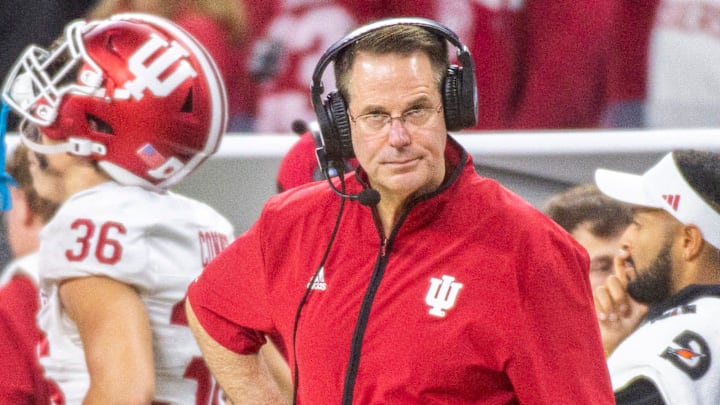
When it was announced that the College Football Playoff was expanding from four to 12 ahead of the 2024 season, there is not a person on earth, maybe outside of Curt Cignetti, who would have believed you if told them in two years, undefeated Big Ten Champion Indiana was going to be the No. 1 seed of a playoff that includes Tulane, James Madison, and no teams from the ACC.
Yet, here we are. Undefeated Indiana is a conference champion. Five-loss Duke is a conference champion. 10-2 Vanderbilt is sending its quarterback to New York as a Heisman finalist, and oh yeah, Texas Tech is a conference champion and one of the scariest teams in the country.
It’s wild how fast things can change when everybody can pay the players, isn’t it, Alabama Jones?
Everything has changed in college football, and yet, we still leave it up to a committee of flawed and biased people to determine who gets a chance to play for a national championship. Bring back the BCS? No! This is too much fun, and the arguments on Sunday when the 12-team College Football Playoff is finally released are going to fuel me till the New Year. Let’s go!
First Course
1. Indiana football has no fear (No. 2 Indiana 13 No. 1 Ohio State 10)
Two years removed from a 3-9 season, Curt Cignetti just led the Indiana Hoosiers, the program that had the most losses in FBS history, to a 13-0 season and its first outright Big Ten Title since 1945. That’s the most impressive turnaround in college football history, and I’m sure you can argue against that. It might be the best coaching job ever in the sport, and this team still has a whole hell of a lot in front of it this season.
Cignetti deserves an insane amount of credit for the success, as does Fernando Mendoza, who almost certainly locked up the Heisman Trophy on Saturday night in Indianapolis. Ryan Day deserves a bit too for two second-half trips inside the Indiana 10-yard line that yielded no points. However, I didn’t come here to litigate Ryan Day’s fourth-down cowardice; that’s pretty cut-and-dry. I’m here to talk about Bryant Haines, who may have been the coach most responsible for Indiana’s Big Ten Title Game upset.
It’s borderline unfathomable that the coaching staff responsible for the greatest turnaround in college football history hasn’t been raided, especially after a historically wild coaching carousel, but Cignetti can’t keep Haines a secret forever. What he did against Julian Sayin, Jeremiah Smith, and the Ohio State offense might deserve a statue in Bloomington.
Last year, Will Howard gave Ohio State the numbers advantage it needed to dominate in the running game. This year, Day and Brian Hartline evolved into a 12-personnel team to get the ground attack going. The
Defenses have to respect Smith and Carnell Tate on the outside, so as Michigan did last week when Ohio State ran for 186 yards, most defensive coordinators will play nickel and keep two safeties deep. That keeps a roof on the explosive passing game, but sacrifices numbers in the box. If you load the box, then you’re vulnerable to the explosive passing game. That’s why 12 personnel has become in vogue throughout the NFL this season, with teams like the Rams and the Seahawks using it most effectively.
Well, Haines and Cignetti were not about to let Ohio State bury them with four and five-yard runs. Indiana has played more base defense, with four defensive linemen and three true linebackers, than just about any team in the country this season. They didn’t just match Ohio State’s 12 personnel with base; they played base into 11 personnel, most notably on third-and-6 from the Indiana seven-yard line when linebacker Isaiah Jones chased Julian Sayin down for a sack to force a field goal.
With Jones, Aiden Fisher, and Rolijah Hardy on the field for the majority of the defensive snaps, Indiana held Ohio State to 2.2 yards per carry, an abysmal -0.62 EPA/rush, and a 29 percent rushing success rate. The most staggering part is that Indiana also allowed just one explosive pass all game and only -0.12 EPA/dropback. That’s absurd. That’s dominance. That might be the best defense in the country. It’s certainly the best defensive performance, considering opponent and context, all year.
If you’re going to live that way, especially with the amount of two-deep safety zone coverages that Haines played behind a heavy front, you need linebackers who can cover and tackle in space. Fisher, Hardy, and Jones were all excellent in that capacity. They weren’t the only ones who submitted superstar performances, though.
If you’re playing deep safeties and seven-man fronts, there’s going to be a whole lot of space in the middle of the field, and for as good a job as Indiana’s linebackers did at getting depth in coverage, there was. So why didn’t Sayin trigger? Well, because Haines had him seeing ghosts, holding onto the ball for 3.42 seconds, and they sacked him five times after he was sacked seven times all year.
Indiana plays so much zone, and predominantly Cover 6, which is quarter, quarter, half in the secondary. They can do that because D’Angelo Ponds is a lockdown boundary corner who allows them to roll coverage to the field, even when most of those one-on-one reps are against the best wide receiver in the country, who has six inches and 50 pounds on Ponds.
Sayin’s interception on the first drive of the game came on that type of cover rotation, which he didn’t recognize. From that point on, he opted to mostly attack outside the numbers, and because he was hesitant to fire, he took five sacks. He was essentially a starting pitcher who gave up an early solo home run and nibbled on the edges the rest of the night.
Indiana lived dangerously on defense all night and got rewarded for it. Ryan Day kicked a field goal from the nine-yard line down three with 2:48 left, and got rewarded for it. Cignetti has no fear; that’s the identity he brought to Bloomington, and Haines’s game plan embodied it.
Second Course
2. Glenn “Dr. Heat” Schumann (No. 3 Georgia 28 No. 9 Alabama 7)
In a game that Georgia ended up leading the entire way, Kirby Smart and Glenn Schumman blitzed Ty Simpson on 60 percent of his dropbacks. The audacity. That’s Gregg Williams, Dr. Heat, levels of bltizing, and it never burned them.
Against the blitz, Simpson completed 10 of his 23 throws for 139 yards and a touchdown, which came on a timely screen pass. Without a dominant pass rusher, Schumann has been cranking that dial all season, but this was his most blitz-heavy game of the season, and it was well-timed. Not only was Alabama down an offensive lineman in starting left guard Kam Dewberry, but the Tide were without senior starting running back Jam Miller and redshirt senior starting tight end Josh Cuevas.
Without Miller and Cuevas, Simpson, who is one of the best pre-snap quarterbacks in the country, couldn’t trust his protection and was under constant duress. The bigger issue, though, was a persistent one. Alabama couldn’t run the football.
The Tide finished the game with -3 total rushing yards. Their -0.33 predicted points added per rush, according to CollegeFootballData.com, was the worst mark of conference championship week, and the worst by an Alabama offense since, strangely, a 35-7 Week 4 win over Arkansas in 2009.
That, along with a lopsided game script, forced Alabama to have a 72 percent early down pass rate. When that’s the case, you don’t have to worry about rush-lane integrity. You can pin your ears back, run stunts, twists, and games, and heat up an opposing quarterback.
Georgia dominated both lines of scrimmage, and though it still relies on the blitz far too much for my liking, at least it’s finally getting home. With Gunner Stockton comfortable in his role as a game manager, particularly without starting center Drew Bobo, who typically makes all the calls at the line of scrimmage but was out with an injury, the Dawgs look like a team that should make the CFP semifinal. But watching the Big Ten Championship Game, it’s hard for me to say that Georgia belongs in that same weight class.
Third Course
3. Oil Money bought a math problem (No. 4 Texas Tech 34 No. 11 BYU 7)
It’s crazy to think that Oil money can buy more than cookie money. Of course, BYU’s NIL operation is funded by more than just Crumbl cookies, but it’s not funded by a brash West Texas oil tycoon. If you want to win in college football, might I suggest going to find one?
Duke and Indiana stole the headlines for their unexpected football success, but on Saturday, Texas Tech won its first outright conference title since it won the Border Conference in 1955. It’s not just that Tech had money to spend in the transfer portal, though. It’s that they knew the right way to spend it because that defensive line is transformational.
The Red Raiders’ whisker-lipped linebackers are great, but it all starts up front for that defense. They only pressured Bear Bachmeier on 10 of his 31 dropbacks and sacked him twice, but Bachmeier’s 2.12-second time to throw and 2.9-yard average depth of target is a direct reflection of that pass rush.
In Week 11, BYU opted to keep tight ends and running backs in to double-team Texas Tech’s edge rushers, David Bailey and Romello Height. That left them with just three players running routes against seven players in coverage. This time, BYU looked to get the ball out of Bachmeier’s hands quickly and live off run after the catch, but Tech had layers in its defense and tackled well. Both times, Texas Tech hardly ever blitzed.
Football is a math problem, and when you can’t block four with five, there aren’t many solutions. Bailey, Height, Lee Hunter, and A.J. Holmes, who was fantastic, warp the geometry of an offense, and on Saturday, they dictated the terms.
BYU is the only team in the Big 12 that spends close to Texas Tech, and the Cougars have had no chance of blocking Texas Tech. I don’t think any of the teams in the Big Ten or SEC will be able to either. This is a championship-caliber defensive line. I don’t think the other side of the ball with Behren Morton is quite on that level, but Texas Tech is deserving of a bye and will not be an easy quarterfinal matchup at all.
Reservations: The season isn’t over yet, but these teams have all but locked up a spot in the CFP
4. The ball, the ball, the ball (No. 20 Tulane 34 No. 24 North Texas 21)
How do you lose a football game in which your team has a 50 percent success rate, averages nearly seven yards per play, and converts on third down at a 53 percent clip? You turn the ball over. That’s exactly what North Texas did on Friday night in rainy New Orleans.
North Texas quarterback Drew Mestemaker finished with three interceptions, one of which went for a touchdown, and his team’s four turnovers led directly to 14 points in a 13-point loss. Two of those three interceptions came when pressured, which Mestemaker was often. Tulane finished with a 24 percent havoc play rate on defense, and defensive end Santana Hopper lived in the backfield with six QB pressures and two sacks.
North Texas head coach Eric Morris is heading to Oklahoma State, and Mestemaker will be one of the most highly sought-after quarterbacks in the transfer portal this offseason, but in their only two games against defenses with real athletes, USF and Tulane, they went 0-2, while Mestemaker threw six of his seven interceptions on the season.
Tulane didn’t do anything special, but it didn’t have to with turnovers leading to a 31-7 second-half lead. That was good enough to claim a seat at the CFP table and earn the right to have a rematch with Ole Miss (currently No. 6), after a 45-10 drubbing in Week 4.
Reservations: Week 9- Texas A&M, Ole Miss, Indiana Week 10- Ohio State Week 11- Alabama, Georgia Week 12- Notre Dame Week 14- Texas Tech, Oregon, Oklahoma
Check Please!: When it’s clear there won’t be a seat for you at the CFP table, it’s time to pay your check and go
5. That’s how the cookie Crumbl(s) (No. 4 Texas Tech 34 No. 11 BYU 7)
In BYU’s 29-7 loss to Texas Tech back in Week 11, the Cougars couldn’t run the ball. Special teams mistakes put them behind early, and with Bear Bachmeier thrust into a dropback passing game against the best pass rush in the nation, it snowballed. This time, BYU, with a well-scripted opening drive and a trick play sprinkled in, jumped out to an early lead. Then, Bear Bachmeier hurt his ankle.
Let me be clear, in no world did I ever think that BYU would be able to move the ball on Texas Tech this time around. However, if Bachmeier can run, you have the benefit of an extra blocker and a fearless 235-pound battering ram coming in behind it. Even against the nation’s top run defense, that’s worth something. With that element stripped away, BYU was helpless.
BYU was determined to run it, evidenced by just a 53 percent early down pass rate despite trailing nearly the entire game. Yet, the Cougars averaged 3.85 yards per play while Texas Tech forced three turnovers and finished with nine tackles for loss.
With two losses to Texas Tech, both by significant margins, BYU is out of the at-large mix for the CFP.
Head of the table: The best individual performance earns the seat at the head of the table
6. Fernando Mendoza, Indiana QB (No. 2 Indiana 13 No. 1 Ohio State 10)
In the first half, after Sayin and Mendoza had both thrown interceptions, Diego Pavia became the betting favorite to win the Heisman Trophy. Then, after a 3-8 start with 20 yards and an interception, Mendoza was money. He finished the game, completing 12 of his final 15 throws for 202 yards and a touchdown. That included the dagger, an absolute beauty of a go-ball to Charlie Becker on third-and-6 to essentially seal the win.
FERNANDO MENDOZA TO BECKER AGAIN 🎯@Indianafootball pic.twitter.com/HMA75IKVHh
— FOX College Football (@CFBONFOX) December 7, 2025
It was the third contest catch deep ball that Mendoza had put right on the money; the other two, one to Becker and one to Elijah Sarratt, set up the Hoosier’s lone touchdown.
In a way, as Bryant Haines dared Julian Sayin to sit back in the pocket, read out the full field against his zone coverage, and beat him with post-snap processing, Matt Patricia and Ohio State kind of did the same. Ohio State played primarily a bear front, which is five down defenders to match the five offensive linemen. It’s a great counter to an outside zone running team, which Indiana is, and it’s what Bill Belichick, Patricia’s mentor, pulled out in Super Bowl 53 to stymie Sean McVay’s offense.
It worked, holding Indiana to 3.5 yards and 0.02 EPA per rush. But, rather than play with two-deep safeties and potentially expose the middle of the field against Mendoza, one of the game’s better throwers to the middle of the field, especially off play-action, Patricia let Caleb Downs patrol as a free safety and had his big physical corners man up on the outside. Only problem, Indiana’s wide receivers are bigger and physical(er), and Mendoza can drop it in a bucket as well as he can rip it over the middle. Becker and Sarratt converted all four of their contested catch opportunities, and Becker finished with six catches for 126 yards.
Mendoza’s performance in Indy, while it netted just 13 points, won’t just win him the Heisman Trophy; it will make him the No. 1 pick this spring.
Tasting menu: When there are just a few seats left at the table, it comes down to preference.
7. Alabama: No. 9, 10-3, SEC Runner-up
For my taste, Alabama is absolutely deserving of an at-large bid into the CFP field. Yes, the Tide got stomped in Atlanta and looked completely lifeless, but Alabama beat that Georgia team that looked like world beaters in Athens 10 weeks ago. Until Indiana beat Ohio State on Saturday night, that was the best win any team had all season.
The reason I think they should be in is that in a 12-team format, when all the bubble teams are flawed, I believe you should favor resume over eye test. The reason I think they will be in, however, is that the SEC makes millions of dollars off the SEC Championship Game every year. As does the Big Ten of its title game. The CFP is predominantly run by those two entities, and you could assume that they would prefer that the CFP not kill their cash cow.
If Alabama was in before the SEC title game and drops out after, then there’s an undeniable argument that the league’s conference title game hurt itself. With that, the coaches will, understandably, lobby for them to go away, and the CFP cannot have that.
While that borders on conspiracy, I also think it’s fair. Especially when the argument has Notre Dame on the other side. Grow up. Join a conference.
8. Notre Dame: No. 10, 10-2
There are essentially two spots for Alabama, Notre Dame, and Miami. If you asked me which of those three teams I think has the best chance of winning a national championship, I’d honestly answer the Fighting Irish. Yet, they’re easily the team I’d leave out of the field. They matched Alabama’s 10-2 record despite playing the 42nd-ranked strength of schedule, and their best win is over USC at home, while Alabama beat Georgia on the road.
I think Notre Dame will get in over Miami, with Alabama dropping to No. 10 and remaining the committee’s shield between the Notre Dame and Miami argument, but I think Miami should have stayed in front of Notre Dame all along, thanks to the fact that, you know, Miami beat Notre Dame.
9. Miami: No. 12, 10-2
Head-to-head is not everything, but if it’s not the tiebreaker when it’s close, then the games don’t matter. Even the sport’s most prolific prognosticators can’t pick games 100 percent. As much as we think we know, and as the committee thinks they know, about this sport, we’re wrong, and they’re wrong, about teams all the time. The hubris it takes to have seen two teams play, seen them finish the year with identical records and similar resumes, and then emphatically declare that the losing team is better, is honestly aspirational. I’d love to have that level of self-confidence.
Though until I reach that point in my journey of self-discovery, I’m going to defer to the games that happened on the field over my opinion. They played. Miami won. What are we doing?
10. Duke: Unranked, 8-5, ACC Champion
As I said, resumes matter, and a resume is much more than a win-loss record. Yes, Duke is 8-5 after beating Virginia in overtime for the ACC Title. And yes, James Madison finished as a 12-1 Sun Belt Champion and finally broke through into the top 25 in the penultimate rankings of the year. But no, I wouldn’t put the Dukes in over Duke.
Manny Diaz said it on the field after beating Virginia in overtime, that win, over the committee’s No. 17-ranked team, is leaps and bounds better than anything JMU has done this season. It’s one Power 4 test came against Louisville, which finished seventh in the ACC, and it lost 28-14.
Duke is not a good team, and the ACC is not a good conference, but of its five losses, it avenged one on Saturday, and another was to a College Football Playoff team in Tulane. It’s honestly wild that two years into the 12-team format, we’ve had Boise State and Arizona State get first-round byes because of goofy seeding rules that were thankfully fixed for this year, and now we’re on the cusp of a playoff with two teams from outside the Power 4.
11. James Madison: No. 25, 12-1, Sun Belt Champion
I didn’t think the committee was going to put James Madison in over Duke until the Dukes crept into the rankings at No. 25 on Tuesday night. Now, I think there’s a greater than 50 percent chance that it happens, but certainly not 99.9%. This is a good chance to get on my soapbox, so if you’re still reading, thank you.
There is no mathematical formula for determining how 12 human individuals will arbitrarily select the field for the 12-team College Football Playoff, so there is no mathematical way to predict it. The All-State Playoff predictor makes no sense and should be given zero credibility. If you’re going off the betting odds, James Madison (as of 1:33 a.m. ET on Sunday morning) is -8000 to make the field, which is an implied probability of 98.77 percent. I still think it’s much closer to 70/30 in favor of the Dukes over Duke, but I’ll trust the people with real money at stake over ESPN’s arbitrary calculator.
12. Texas: No. 13, 9-3
No.
Okay, I have more to say than just No.
Maybe being left out has more to do with a loss to Florida and letting Mississippi State and Kentucky take you to overtime in back-to-back weeks than it does a loss to Ohio State. Handle your business, and that loss helps you.
 Add us as a preferred source on Google