

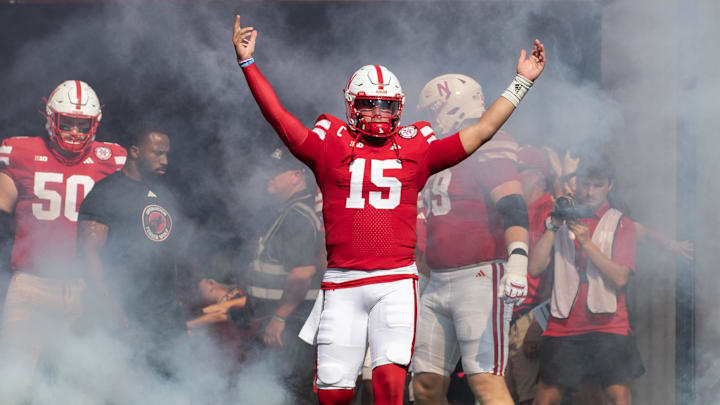
The last four Heisman Trophy winners have all been transfers, and three of them were quarterbacks: Caleb Williams, Jayden Daniels, and Fernando Mendoza. So there's a great chance that the 2026 Heisman Trophy winner will be on the move when the Transfer Portal opens from January 2 to January 16.
Saturday Blitz Transfer Portal rankings 2026: QB, WR, RB, TE, OL, EDGE, DL, LB, CB, S
This year, with just one Transfer Portal window, along with a wild coaching carousel, we already have a robust quarterback market, and it may get even better as players continue to announce their intention to enter the portal this winter. Even with plenty of supply in the portal, the demand for a top-tier quarterback is as high as ever. The top of the market is expected to be around $5 million for the top portal QBs this offseason.
So, who should your favorite team spend its money on? Well, factoring in remaining eligibility, production, and of course, potential (because who doesn't love a mystery box), these are your official Saturday Blitz 2026 quarterback rankings:

Last rankings update: 10:00 a.m. ET, 1/8/2026
1. Brendan Sorsby - Cincinnati (Committed: Texas Tech)
Brendan Sorsby had flashed talent when he was a young Indiana transfer leaving for Cincinnati. Now, after two seasons with the Bearcats, the redshirt junior is one of the cleanest quarterbacks in college football. He attacks downfield and throws with great touch when threatening defenses vertically, but his best abilities are with his feet.
That’s not just as a runner, which is a real element for the big physical quarterback who gets downhill as a scrambler and on designed QB runs, and finished sixth among all players in EPA/rush this season. That’s also in the pocket. Sorsby’s elite pocket movements allowed him to post a pressure-to-sack rate of just 6.2 percent, and his crisp footwork allows him to quickly click through his progressions and reset to make accurate throws all over the field. Sorsby is entering the portal and testing the NFL Draft waters, and he’ll command a big deal to stay in school because I think he’ll be pleasantly surprised by the feedback he gets from the league.
2. Sam Leavitt - Arizona State
Leavitt is an excellent athlete who, when he had the benefit of an elite run game in 2024, used it to become an elite negative play mitigator who could still push the ball downfield and hunt big plays, particularly off play-action. In 2025, with Cam Skattebo gone, Leavitt had to up his risk profile and create more as a scrambler. However, that also led to more sacks and writing a few more checks that his arm just couldn’t quite cash.
While he may not have an elite arm, Leavitt is accurate and aggressive, capable of hitting tight window throws both over the middle of the field and to the boundary. If he can get behind a better offensive line with a better run game and reclaim a better decision-making balance, he could be the best quarterback in the country.
3. Demond Williams - Washington
Demond Williams is undersized at 5-foot-11, but that’s about where his physical limitations end. He has the arm spray the ball all over the field, is accurate throwing on the run, and put up over 600 yards on the ground in his first year as a starter in Jedd Fisch’s offense. Despite his size, Williams manages pressure well, and his athleticism allows him to nurse a small pressure-to-sack-rate.
Where Williams’ lack of size shows up is where it always shows up for small quarterbacks: throws over the middle. While he’s a more than capable thrower between the numbers, that’s where six of his eight interceptions came in 2025.
4. Drew Mestemaker - North Texas (Committed: Oklahoma State)
In his first year as a starting quarterback since his freshman year in high school on a B team, Mestemaker looked the part. The former North Texas walk-on tore up the American for 4,131 yards and 31 touchdowns to just seven interceptions while completing 70.1 percent of his throws and averaging 9.9 yards per attempt.
Now, Oklahoma State head coach Eric Morris runs a QB-friendly system, and Mestemaker certainly benefited from open receivers and the larger throwing windows of the Group of Six. So, maybe his longer release will need to quicken as he makes the jump to the Power 4, or his wide throwing base will become more difficult maintain in muddier pockets, but his accuracy will absolutely translate. It’s not just accuracy in terms of completion percentage; it’s his ideal ball placement to protect his receivers or set them up for yards after the catch that is so staggering on film. I’ll bet on an accurate passer with a big arm and athleticism any day.
5. DJ Lagway - Florida
The five-star showed flashes of absolute brilliance as a true freshman in 2024, enough to keep Billy Napier’s job heading into 2025. He has unreal arm talent and a sturdy frame that has drawn him Ben Roethlisberger comparisons as a tough to bring down play-extender who is always hunting the deep shot.
Like ‘Big Ben,’ though, Lagway has battled injuries almost constantly through his two college seasons. Without a proper offseason heading into 2025, due to shoulder and foot issues, Lagway never looked to be on the same page with his receivers and floundered in Napier’s disjointed offense. Whichever team pays up to pluck him out of the portal is taking a chance that they’ll do a better job developing him than Florida did, and while they’d be justified in that belief, you can only keep your fingers crossed that the production will start to match the talent for so long.
6. Dylan Raiola - Nebraska
It’s no secret who Dylan Raiola models his game after, and the Nebraska sophomore pulled off some impressive off-platform throws with his live arm through his two seasons starting in Lincoln. However, that and the look are really where the similarities end between Raiola and Patrick Mahomes.
Raiola was a hyper-efficient passer in Dana Holgorsen’s offense, finishing fourth in the country in EPA/dropback, thanks to his decisiveness as a thrower and accuracy from the pocket. His nonchalant style, though, borders on lackadaisical, and because he’s not an elite athlete, his sack avoidance numbers are putrid. Nebraska’s offensive line was certainly responsible for the amount of pressure he faced, but his pressure-to-sack rate was the worst in the FBS at 34.1%.
Raiola is incredibly talented, but unless he can bring his sack numbers down to keep his offense on schedule more often, the juice won’t be worth the squeeze.
7. Byrum Brown - USF (Committed: Auburn)
Byrum Brown is not the most polished thrower in the world. He has a long, looping delivery that seems to come from his hip, delays his release, and, at times, affects his accuracy. But, he’s got a cannon for an arm, great touch on downfield throws, and he sheds tacklers like a running back.
Brown is an electric factory of a quarterback, creating big plays constantly. Finally healthy for a full season in 2025, he posted 3,158 passing yards with 28 touchdowns to seven interceptions while rushing for 1,008 yards and 14 touchdowns on the ground. With just one year of eligibility remaining, Brown slides behind Mestemaker, Lagway, and Raiola, who may all be two-year starters with major upside at their next stops.
8. Josh Hoover - TCU (Committed: Indiana)
Josh Hoover has the arm to spray the ball all over the field from the pocket, and when he’s hot, he can be one of the most prolific passers in the country. However, he’s streaky and can run cold as well. When Hoover misses, he tends to miss in high danger areas, sailing throws over the middle of the field.
Hoover can make just about every throw, and even if he can’t, he's going to try it. That led to a 4.4 percent turnover worthy play rate, and 13 interceptions. If he’s willing to play within the confines of the offense a bit more and has a wide receiver corps capable of winning the 50/50 balls he throws up, he can be elite for his final season of eligibility, but if he doesn’t clean up his decision-making, then he’ll put a hard ceiling on his new offense.
9. Rocco Becht - Iowa State (Committed: Penn State)
Can you argue that Rocco Becht’s 3,500-yard, 25-touchdown 2024 season was a product of his two NFL wide receivers at Iowa State? Absolutely. But you also have to acknowledge that this season, he was hamstrung by a wide receiver group with a 9.7 percent drop rate, the 13th highest in the FBS this season, as he threw for 2,500 yards, 16 touchdowns, and matched his 7.6 yards per attempt.
Becht doesn’t have absurd physical tools, but, much like Brock Purdy in the NFL, he knows his limitations and rarely ventures outside of them. Becht protects the football and can create outside of the pocket. Iowa State offensive coordinator Taylor Mouser also tended to lean on his legs in high leverage spots, and for a 6-foot-1, 210-pound quarterback, he’s been a first-down machine as a runner. His size, however, is part of the season that Becht tends to wilt under pressure, averaging 5.4 yards per attempt with four interceptions and no touchdowns when pressured in 2025.
10. Aaron Philo - Georgia Tech
In his lone start of 2025, the redshirt freshman efficiently picked apart Gardner-Webb for 373 yards on 21-of-28 passing with a touchdown and an interception. He carried the ball just three times for 14 yards in relief of the dual-threat Haynes King. However, as a true freshman in 2024, Philo displayed that he can be a bit of a run threat for offensive coordinator Buster Faulkner. Now, Faulkner is at Florida, and there’s plenty of smoke that Philo will be following him.
Though it’s come in a small sample size, Philo has proven to be a sound processor with an accurate arm and more than enough tools for an SEC or Big Ten program to take a chance on him. He’s almost as big a loss for the Yellow Jackets as Faulkner is, and the two would be an enticing package deal as John Mateer and Ben Arbuckle were to Oklahoma or Devon Dampier and Jason Beck were to Utah.
11. Deuce Knight - Auburn
12. Katin Houser - East Carolina (Committed: Illinois)
The former Michigan State transfer found a home as the Pirates’ starting quarterback for the last two seasons under offensive coordinator John David Baker, who left to replace Charlie Weis Jr. at Ole Miss. Baker runs an up-tempo spread system, and to succeed in that style of offense, a quarterback needs to be accurate on short and intermediate throws to maximize yards after the catch and keep the chains moving. Houser does that well, but that’s not to say he’s a check-down Charlie.
When the 6-foot-3, 225-pound Californian has a chance to push attack vertically, he throws the deep ball with pace, touch, and an impressive recognition of leverage. His precise downfield ball placement tends to give his receiver the best chance to make a play on the ball, and that skill translates to any system. Houser can use his size and athleticism in the run game, particularly around the red zone, but he has some limitations as a second-reaction creator, completing just 53 percent of his throws on dropbacks over 2.5 seconds.
 Add us as a preferred source on Google